Cancer starts when cells in the body change and grow out of control. These cells can form lumps called tumors. Cancer that starts in the cells of the pancreas is called pancreatic cancer.
Understanding the pancreas
The pancreas is a gland, an organ that makes substances the body needs. It's located in the left side of the belly (abdomen), behind the stomach and in front of the spine.
The pancreas has two main jobs:
-
It makes pancreatic enzymes. These enzyme juices help digest food. They go into the small intestine to help break down food.
-
It makes hormones. These include insulin and glucagon. They help control the amount of sugar (glucose) in the blood.
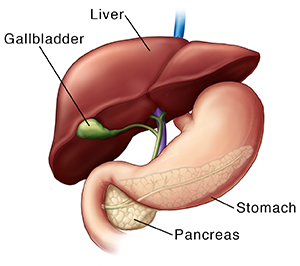
When pancreatic cancer forms
Pancreatic cancer forms when cells in the pancreas change (mutate) and grow out of control. This can change the way the pancreas works. Pancreatic cancer can spread into nearby organs, like the intestines, liver, and gallbladder. It can also spread to other parts of the body. This spread is called metastasis. The more cancer spreads, the harder it is to treat.
Treatment choices for pancreatic cancer
You and your healthcare provider will talk about treatment and make a plan that's best for you. Your treatment choices may include:
-
Surgery. This removes the cancer in the pancreas. Sometimes nearby tissues and organs are also removed.
-
Radiation therapy. This aims high-energy X-rays at the tumor to kill cancer cells.
-
Chemotherapy. This uses strong medicines to kill fast-growing cells like cancer cells. Chemotherapy and radiation therapy can also be given together. This is called chemoradiation.
-
Immunotherapy or biologic therapy. This uses medicines that boost the body's natural immune system to better fight the cancer.
-
Targeted therapy. This uses medicines that focus on specific changes found only or mostly on the cancer cells, such as genetic changes or proteins. These medicines then kill the cancer cells. But it limits damage to normal cells.
Featured in
Online Medical Reviewer: Kimberly Stump-Sutliff RN MSN AOCNS
Online Medical Reviewer: L Renee Watson MSN RN
Online Medical Reviewer: Todd Gersten MD
Date Last Reviewed: 06/01/2016
© 2000-2026 The StayWell Company, LLC. All rights reserved. This information is not intended as a substitute for professional medical care. Always follow your healthcare professional's instructions.


