Definition

Anatomy of the Sacroiliac Joint

Choose a preferred language

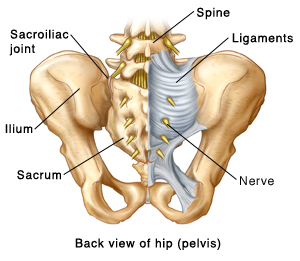
There are 2 sacroiliac (SI) joints. They are in the very low back (buttocks area). There is 1 joint on either side of the pelvis. The SI joints link the sacrum to the ilium. The sacrum is a triangular bone at the bottom of the spine. The ilium is part of the pelvis. The SI joints are held in place by ligaments. Ligaments are strong tissue that link bone to bone. The joints don't move very much. But they do help with mobility. They work with your spine and femurs to help you bend and walk. They also help bear the weight of your upper body.
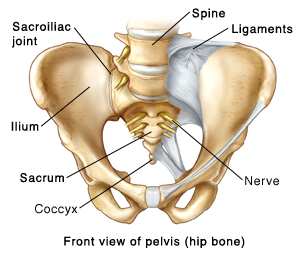
Front view of the pelvis (hip bone) showing the sacroiliac joint showing the spine, ligaments, ilium, sacrum, coccyx, and nerve.

Back view of the hip (pelvis) showing the sacroiliac joint, spine, ligaments, ilium, sacrum, and nerve.

Online Medical Reviewer: Louise Cunningham RN BSN

Online Medical Reviewer: Raymond Turley Jr PA-C

Online Medical Reviewer: Thomas N Joseph MD

Date Last Reviewed: 08/01/2024

© 2000-2026 The StayWell Company, LLC. All rights reserved. This information is not intended as a substitute for professional medical care. Always follow your healthcare professional's instructions.



Make an Appointment

Make an Appointment

Find a Doctor

Find a Doctor

Find a Location

Find a Location

Related Services

Orthopedics Center

Related Articles
Read article
Orthopedics
Anatomy of a Normal Spine

Learn about the spine with these helpful detailed illustrations.

Read article
Urgent Care
Broken or Bruised Nose, No X-Ray

A contusion (bruise) in the nose can cause pain, swelling, and stuffiness, as well as bleeding from the nose. A minor fracture can occur at the same time.

Read article
Orthopedics
Bone Cyst

A bone cyst is a hole, or cavity, inside your bone that is filled with fluid. Learn how to treat and care for a bone cyst.

Read article
Orthopedics
Common Types of Fractures

Bones anywhere in the body can break. Casts are often used for fractures in the hands, arms, legs, or feet. There are many types of fractures. But all fractures heal the same way: New bone grows to connect the broken pieces. A cast holds broken bones in place while they heal.
