Your foot is made up of soft tissue and bones that work together to form a healthy, functioning, and pain-free foot.
-
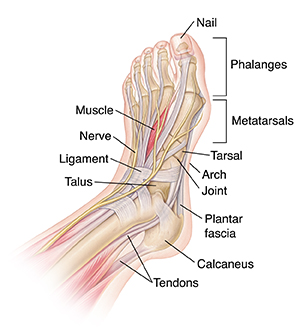
Muscles contract and relax to move the foot.
-
Tendons are tough fibers that connect muscles to bones.
-
Ligaments are fibrous strands that connect bones.
-
Nerves travel throughout the foot, providing feeling.
-
Nails protect the tips of the toes.
-
Phalanges are the toe bones.
-
Metatarsals are the bones between the toes and the ankle bones.
-
Tarsals are bones of the rear foot (hindfoot) or middle foot (midfoot).
-
The talus is one of the ankle bones.
-
The calcaneus is the heel bone.
-
The arch is formed by bones and held in place with ligaments.
-
Joints are the meeting points between two bones. They are lined with cartilage. Cartilage is smooth tissue that allows joints to move easily.
-
The plantar fascia is a sheet of fibrous tissue that supports the arch and encloses muscles there.
Online Medical Reviewer: Raymond Turley Jr PA-C
Online Medical Reviewer: Stacey Wojcik MBA BSN RN
Online Medical Reviewer: Thomas N Joseph MD
Date Last Reviewed: 08/01/2022
© 2000-2026 The StayWell Company, LLC. All rights reserved. This information is not intended as a substitute for professional medical care. Always follow your healthcare professional's instructions.


