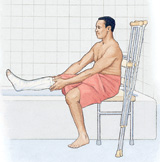
These tips will help you care for your splint at home:
-
It will take up to 48 hours for your plaster splint to fully harden. Don’t put pressure on it during this time or it may break. Don’t walk on foot or leg splints. They may break, even when dry.
-
To stop swelling under the splint, for the first 48 hours:
-
If the splint is on your arm, keep it in a sling or raised to shoulder level when sitting or standing. Rest it on your chest or on a pillow at your side when lying down.
-
If the splint is on your leg, keep it propped up above the level of your heart when sitting or lying. Sleep with it raised on a few pillows. As much as possible, don't do any crutch walking during this time.
-
-
Keep the splint dry at all times. Bathe with your splint well out of the water. Protect it with 2 large plastic bags. Separately close the top end of each bag with a rubber band or tape. If your splint gets wet, contact your healthcare provider for further directions.
-
Don't stick objects, such as a coat hanger, inside the splint. Don't put powder or cream inside the splint for itchy skin. If itching doesn't go away, call your healthcare provider.
-
Look at the skin around the splint every day.
-
Look at the splint every day to make sure it's not damaged.
Follow-up care
Follow up with your healthcare provider as advised.
When to get medical advice
Call your healthcare provider right away if any of these occur:
-
The splint gets wet or soft, or it cracks
-
Skin around the splint looks red, raw, or swollen
-
Itching under the splint gets worse or doesn't get better
-
Bad odor from the splint or fluid from the wound stains the splint
-
Tightness or pressure under the splint gets worse
-
Fingers or toes become swollen, cold, blue, numb, or tingly
-
Pain under the splint gets worse even when taking pain medicine
-
Splint is too loose
-
You have a fever or chills
Online Medical Reviewer: Kenny Turley PA-C
Online Medical Reviewer: L Renee Watson MSN RN
Online Medical Reviewer: Thomas N Joseph MD
Date Last Reviewed: 03/01/2025
© 2000-2026 The StayWell Company, LLC. All rights reserved. This information is not intended as a substitute for professional medical care. Always follow your healthcare professional's instructions.


