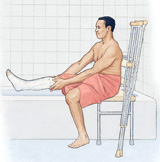
It may take up to 2 hours for the fiberglass to get completely hard. Don’t put any weight on the cast during that time or it may break.
To prevent swelling under the cast, do the following for the first 2 days (48 hours):
-
If the cast is on your arm. Keep it in a sling or raised to shoulder level when you are sitting or standing. Rest it on your chest or on a pillow at your side when lying down. Keep the cast above the level of your heart.
-
If the cast is on your leg. Keep it propped up above the level of your hip when you are sitting or lying down. Sleep with the cast raised on pillows. Prevent crutch walking as much as possible during this time.
Keep the cast completely dry at all times. Bathe with your cast well out of the water. Protect it with 2 layers of plastic, such as 2 large plastic bags, kept in place with rubber bands or tape. Or you may use a waterproof shield. If your cast does get wet, you may use a hair dryer on the cool setting to dry it. A wet cast may cause skin problems.
Don’t put creams or objects under the cast if you have itching. If itching persists, contact your doctor.
Follow-up care
Follow up with your doctor as advised.
When to get medical care
Contact your doctor right away if:
-
The cast cracks.
-
There is a soft or weak spot in the cast.
-
The cast and padding get wet and stay wet for more than 24 hours.
-
There is a bad smell from the cast or wound fluid stains the cast.
-
The tightness or pressure under the cast gets worse.
-
Your fingers or toes become swollen, cold, blue, numb, or tingly.
-
You can’t move your fingers or toes.
-
The pain under the cast gets worse or you have a burning feeling.
-
The skin around the cast becomes red or irritated.
-
You have a fever of 100.4ºF (38ºC) or higher, or as advised by your doctor.
-
You have shaking chills.
Online Medical Reviewer: Kenny Turley PA-C
Online Medical Reviewer: L Renee Watson MSN RN
Online Medical Reviewer: Thomas N Joseph MD
Date Last Reviewed: 07/01/2025
© 2000-2026 The StayWell Company, LLC. All rights reserved. This information is not intended as a substitute for professional medical care. Always follow your healthcare professional's instructions.


