Many people who have an amputation have some degree of phantom sensation. This is when you “feel” the missing part of your limb. You may feel an itch or a tickle. Or it may feel as if the missing part of your leg is asleep. It is most often mild, not painful.
But sometimes you may have stronger, painful sensations that seem to come from the missing part of your limb. It may feel like a quick zing or flash up your limb. Or it may feel more like burning, twisting, cramping, or aching. When this happens, it’s called phantom pain. Persistent phantom pain is far less likely to happen than phantom sensation. And there are things you can do to feel better.
What causes phantom sensation?
Experts don’t know why phantom sensation happens. One common theory has to do with nerves. Nerves that supplied sensation to the missing part of your limb are often still functioning. They are just higher up in your limb. This means that your brain may not know how to interpret signals from these nerves. Your brain may think that the signals are coming from the missing part of your limb.
Phantom limb sensation is a diagnosis of exclusion. This means other possible causes must be ruled out. These include poor blood flow, infection, nerve tumor, and pressure wounds. Certain things may trigger phantom pain, such as smoking, chest pain, cold temperatures, or certain physical actions.
Phantom pain
Phantom pain is likely to come and go. It may happen more often at night. Keep in mind that you won’t necessarily have phantom pain after your amputation. It’s far less common than phantom sensation. Phantom pain is most often manageable. But if it becomes hard to live with, talk to your healthcare provider.
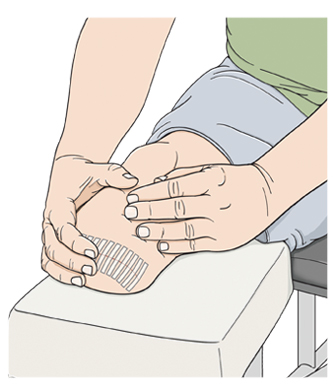
Once stitches or staples come out, spend time every day gently rubbing and tapping your residual limb. This will help desensitize it. Phantom pain often improves over time.
Treating phantom pain
There are several ways to treat phantom pain. If needed, ask your healthcare provider if any of these options might work for you. Those listed below are the most common treatments. Your healthcare provider may recommend others.
-
Medicine. Antiseizure medicine, antidepressants, or other nerve medicines are often used to treat phantom pain. They may work better for this type of pain than normal painkillers.
-
Frequent touch. Massaging, rubbing, and tapping the end of the residual limb helps with desensitization. This can reduce or relieve pain. You may begin massaging your residual limb once the surgical stitches (sutures) or staples are removed.
-
Acupuncture and biofeedback.
-
TENS unit. (transcutaneous electrical nerve stimulation)
-
A shrinker sock. Keeping constant pressure on the end of the limb may help to relieve phantom pain.
-
Your prosthesis. Like wearing a shrinker sock, using a prosthesis provides steady pressure to the limb. This seems to reduce phantom pain for some people.
Online Medical Reviewer: L Renee Watson MSN RN
Online Medical Reviewer: Raymond Turley Jr PA-C
Online Medical Reviewer: Thomas N Joseph MD
Date Last Reviewed: 06/01/2018
© 2000-2026 The StayWell Company, LLC. All rights reserved. This information is not intended as a substitute for professional medical care. Always follow your healthcare professional's instructions.


