Recovery

Knee Rehabilitation: Heel Raise

Choose a preferred language

After you regain muscle control, it’s time to build strength. This helps you put full weight on your leg. For best results, warm up and stretch before starting. If your injury is recent, wait until swelling and pain decrease before doing this exercise.

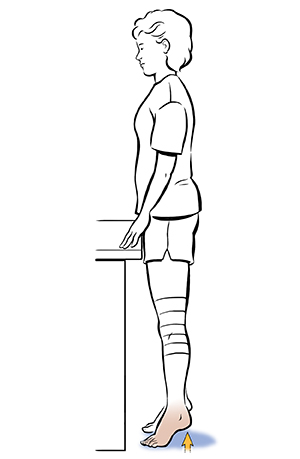
  • Stand with your back straight. Use one or both hands to hold on to a sturdy chair, railing, counter, or table.

  • Rise up on your toes, then slowly lower your heels to the floor.

  • Repeat at least  10 times. Do this  2 to 3 times per day.

Woman standing on tiptoes and holding on to chair for support.

Online Medical Reviewer: Daphne Pierce-Smith RN MSN

Online Medical Reviewer: Thomas N Joseph MD

Online Medical Reviewer: Trina Bellendir PT

Date Last Reviewed: 03/01/2024

© 2000-2026 The StayWell Company, LLC. All rights reserved. This information is not intended as a substitute for professional medical care. Always follow your healthcare professional's instructions.



Make an Appointment

Make an Appointment

Find a Doctor

Find a Doctor

Find a Location

Find a Location

Related Services

Orthopedics Center

Related Articles
Read article
Orthopedics
Getting Into a Shower Stall With a Walker

Here are images showing how to get into a shower stall if you use a walker.

Read article
Orthopedics
Discharge Instructions: Using a Cold Water Therapy Device

Your doctor prescribed a cold water therapy device. This device helps reduce pain and swelling and aids recovery. Here's what you need to know about home care.

Read article
Orthopedics
Discharge Instructions: Using Crutches (Weight-Bearing)

Your healthcare provider has prescribed crutches for you. A healthy leg can support your body weight, but when you have an injured leg or foot, you need to keep weight off it. Once you are told that you can put some weight on your leg, use a "weight-bearing" method of walking as the leg heals.

Read article
Orthopedics
Crush Injury of the Foot, No Fracture

A crush injury to your foot causes local pain, swelling, and sometimes bruising. There are no broken bones. Learn how to care for your injury at home.