Dismiss Modal

Treatment

Hip Arthroscopy: Repairing Synovitis and Arthritis

Choose a preferred language

Synovitis of the hip causes the lining of the joint (synovium) to become inflamed, painful, and swollen. With arthritis, a large amount of the firm, smooth tissue covering the “ball” and “socket” of the hip (cartilage) is damaged. Using only small incisions and special tools, arthroscopy can help fix synovitis and arthritis.
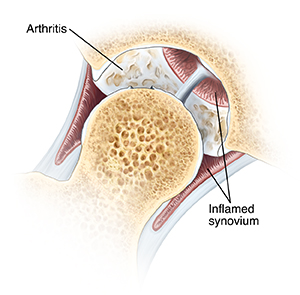
Cross section of hip joint with femoral head moved out of socket. Cartilage lining socket is damaged. Synovium lining joint is inflamed.


In the operating room

Just before surgery, you may be asked several times which hip is to be treated. This is a standard safety measure. In the operating room, you will likely receive medicine (anesthesia) to make you sleep or numb the area.


During the procedure

After you receive anesthesia, your leg is gently pulled to widen the hip joint. Next, the surgeon makes a few small incisions called portals. Through these portals, the surgeon inserts surgical tools, including the arthroscope. The arthroscope sends images of the joint to a screen. These images allow the surgeon to look inside the joint. The joint is filled with sterile fluid to help the surgeon see more clearly.


Repairing synovitis and arthritis

For synovitis, part of the damaged synovium is removed. This may be done by shaving tissue using special tools. For arthritis, the loose or torn cartilage is removed. Or it may be smoothed with a shaver. Arthritis can lead to bone spurs. If bone spurs are present, they may be removed. Once the surgeon finishes, the portals are closed and bandaged. Then you are taken to the recovery room.
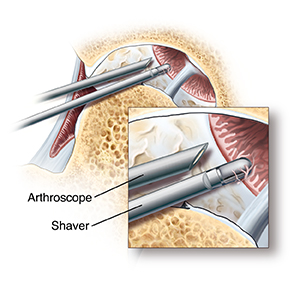
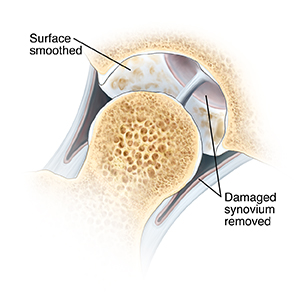
Cross section of hip joint with femoral head moved out of socket. Cartilage lining socket is damaged. Synovium lining joint is inflamed. Arthroscopic instruments are in joint near top of socket. Closeup of arthroscope tip inside joint with shaver removing damaged synovium.Cross section of hip joint with femoral head moved out of socket. Cartilage lining socket is smoothed. Damaged synovium is removed.

© 2000-2026 The StayWell Company, LLC. All rights reserved. This information is not intended as a substitute for professional medical care. Always follow your healthcare professional's instructions.



Make an Appointment

Make an Appointment

Find a Doctor

Find a Doctor

Find a Location

Find a Location

Related Services

Orthopedics Center

Related Articles
Read article
Orthopedics
Foot Surgery: Curled Fifth Toe

A curled fifth toe is most often inherited. When the fifth toe curls inward, it moves under the next toe. Then the nail of the curled toe starts to face outward. As a result, you may bear weight on the side of your toe instead of the bottom. This can cause corns and painful nails. There are many nonsurgical treatments available. But if these are not effective, surgery is a choice.

Read article
Orthopedics
Treating Hand Fractures

A fractured bone starts to heal right away. But a treatment called reduction may help you heal better. Reduction is a process that repositions your bones.

Read article
Orthopedics
Patella (Kneecap) Dislocation or Subluxation, Reduced

The kneecap is held in place by ligaments and tendons. If the kneecap is hit with a strong force, it can slide too far to the side of the knee joint, tearing these ligaments and tendons. This sliding is called subluxation or dislocation.

Read article
Orthopedics
Understanding Clavicle Fracture Open Reduction and Internal Fixation (ORIF)

Open reduction and internal fixation (ORIF) is a type of treatment to fix a broken bone. It puts the pieces of a broken bone back together so they can heal.
