Arthroscopy is used to find and treat many types of knee problems. These include:
-
Meniscal cartilage tears
-
Articular cartilage injuries
-
Knee loose bodies
-
Ligament tears, such as ACL (anterior cruciate ligament) tears
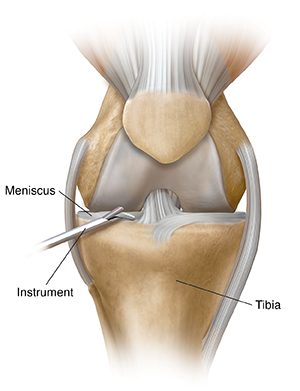
Meniscal cartilage tears
There are several types of meniscal cartilage tears. The meniscal cartilage is attached to the tibia (shinbone). It acts as a shock absorber for the knee. Your surgery will depend on the type and extent of your injury. Your surgeon can remove the damaged tissue or fix the tear. Treatment should ease the pain and swelling. It can also help keep the joint from locking.
Articular cartilage injuries
The ends of the femur and tibia and the back of the patella are covered with articular cartilage. Healthy articular cartilage makes the knee joint easier to move. Articular cartilage can be damaged by injury or normal wear and tear. In many cases, people who have joint injuries, such as meniscus tears or ligament tears, will also have cartilage damage. You may have pain, swelling, stiffness, and limited range of motion. Your surgery will depend on the type and extent of your injury. Treatment options may include removing loose or damaged cartilage, fixing or restoring damaged cartilage, replacing damaged cartilage, or creating tiny holes in the bone beneath the damaged cartilage. This is to stimulate the growth of new cartilage.
Knee loose bodies
Loose bodies in the knee are small fragments of bone or cartilage that break off and float around in the joint space. They can be caused by injury, overuse or repetitive stress, and arthritis. You may have pain, swelling, stiffness, and a feeling of catching or locking in the knee. Your surgery will depend on the type and extent of your injury. Your surgeon can remove the loose bodies.
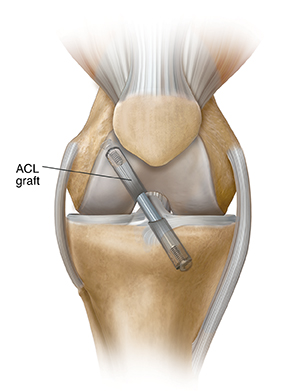
ACL tears
A torn ACL (anterior cruciate ligament) can make the knee unstable. You may have pain and swelling, and your knee may give out. Your surgeon can repair the ACL by reconstructing it. To rebuild your ACL, damaged tissue may be replaced with a graft of healthy tissue from an area near your knee, or from a donor.
Online Medical Reviewer: Rahul Banerjee MD
Online Medical Reviewer: Raymond Turley Jr PA-C
Online Medical Reviewer: Stacey Wojcik MBA BSN RN
Date Last Reviewed: 04/01/2024
© 2000-2026 The StayWell Company, LLC. All rights reserved. This information is not intended as a substitute for professional medical care. Always follow your healthcare professional's instructions.


