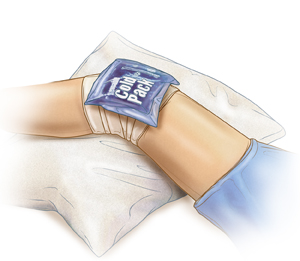
RICE stands for rest, ice, compression, and elevation. These can limit pain and swelling after an injury. RICE may be helpful if you have a broken bone, sprain, strain, bruise, or bump.
Home care
Here are the details of RICE:
-
Rest. Limit the use of the injured body part. This helps prevent further damage and gives the area time to heal. In some cases, you may need a sling, brace, splint, or cast to help keep the body part still until it has healed.
-
Ice. Applying ice right after an injury helps with pain and swelling. To make an ice pack, put ice cubes in a plastic bag. Wrap the bag in a clean, thin towel or cloth. Then place it over the injured area. Do this for 15 to 20 minutes every 2 to 3 hours. Continue for the next 1 to 2 days or until your symptoms improve. Never put ice directly on your skin. Don't ice an area longer than 20 minutes at a time.
-
Compression. Putting pressure on an injury helps reduce swelling and provides support. Wrap the injured area firmly with an elastic bandage or wrap. Make sure not to wrap the bandage too tightly so that you don't cut off blood flow to the area. If the bandage loosens, rewrap it.
-
Elevation. Keeping an injury raised above the level of your heart reduces swelling, pain, and throbbing. For instance, if you have a broken leg, it may help to rest your leg on several pillows when sitting or lying down. Try to keep the injured area elevated as often as possible.
Follow-up care
Follow up with your health care provider as advised.
When to seek medical advice
Call your health care provider right away if:
-
You have fever of 100.4°F (38°C) or higher, or as directed by your health care provider.
-
You have chills.
-
Pain or swelling gets worse.
-
The area is cold, blue, numb, or tingly.
-
You have signs of infection. These include warmth, redness, drainage, or a bad smell coming from the area.
-
You have new symptoms.
Online Medical Reviewer: Joseph, Thomas N., MD
Online Medical Reviewer: Larson, Kim APRN, FNP
Date Last Reviewed: 10/01/2024
© 2000-2026 The StayWell Company, LLC. All rights reserved. This information is not intended as a substitute for professional medical care. Always follow your healthcare professional's instructions.


