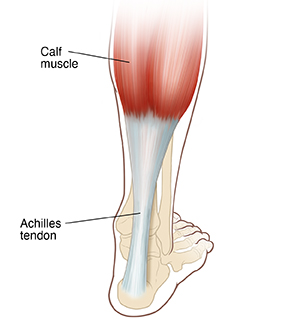
The Achilles tendon is a strong, fibrous cord in the back of your lower leg. It connects the calf muscles to your heel. It’s the largest tendon in your body. It helps you walk, run, and jump. Achilles tendon repair surgery is done to fix the tendon when it's damaged.
Why is Achilles tendon repair surgery done?
The surgery may be done if you have a sudden tear or rupture. It may also be done if you've had overuse, wear and tear, or injury from other problems. This long-term injury may cause the tendon to be inflamed. This is called tendonitis or tendinopathy.
How is this surgery done?
It's done by an orthopedic surgeon. They treat bone, muscle, joint, and tendon problems. The surgery can be done in one of a few ways. The surgeon will make a cut (incision) through the skin and muscle in the back of your calf. If you have minimally invasive surgery, the surgeon will make several smaller incisions instead of one large one. They will make an incision through the sheath or covering of the Achilles tendon. If the tendon is damaged, they may remove the damaged part and repair the rest of it. If you have severe damage, they may use a muscle or tendon from your calf, ankle, or foot for the repair.
What are the risks of this surgery?
Every surgery has risks. Risks depend on things such as your age, overall health, and the type of surgery. And they depend on the shape of your foot, muscles, and tendons.
Risks of this surgery include:
-
Bleeding.
-
Nerve damage.
-
Infection.
-
Blood clots.
-
Wound healing problems.
-
Calf weakness.
-
Problems from anesthesia.
-
Continued pain in your foot and ankle.
Ask your surgeon which risks apply most to you. Talk with them about any concerns you have.
Featured in
Online Medical Reviewer: Raymond Turley Jr PA-C
Online Medical Reviewer: Stacey Wojcik MBA BSN RN
Online Medical Reviewer: Thomas N Joseph MD
Date Last Reviewed: 06/01/2025
© 2000-2026 The StayWell Company, LLC. All rights reserved. This information is not intended as a substitute for professional medical care. Always follow your healthcare professional's instructions.


