Doing exercises before your surgery or procedure can help speed your recovery. These exercises build upper body strength. This can help you when you’re using a walker or crutches to get around after surgery. Your physical therapist or surgeon may advise you to use weights to make the exercises more effective. Follow your healthcare provider’s instructions.
Caution
Stop any exercise that causes sharp or increased knee pain, dizziness, shortness of breath, or chest pain.
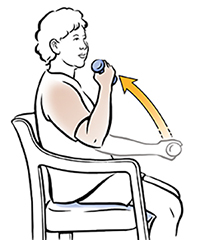
Bicep curls
-
Sit up straight. Keep your elbow close to your body and your wrist straight.
-
Bend your arm, moving your hand up to your shoulder, then lower slowly.
-
Repeat 10 to 15 times, or as advised.
-
Do a set with each arm.
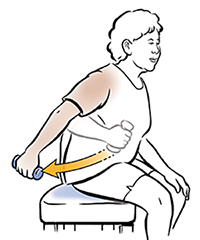
Tricep curls
-
Sit, leaning forward from the waist.
-
Bend your elbow so that your forearm is parallel to the floor. Then straighten your elbow as you extend your arm behind you.
-
Repeat 10 to 15 times, or as advised.
-
Do a set with each arm.
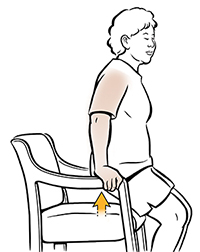
Seated press-ups
-
Sit in a sturdy chair with armrests.
-
With palms flat on the armrests, press down to lift your buttocks from the chair. Hold for 3 to 5 seconds.
-
Bend your elbows to slowly ease back down.
-
Repeat 10 to 15 times, or as advised.
Featured in
Online Medical Reviewer: Rahul Banerjee MD
Online Medical Reviewer: Raymond Turley Jr PA-C
Online Medical Reviewer: Rita Sather RN
Date Last Reviewed: 04/01/2024
© 2000-2026 The StayWell Company, LLC. All rights reserved. This information is not intended as a substitute for professional medical care. Always follow your healthcare professional's instructions.


