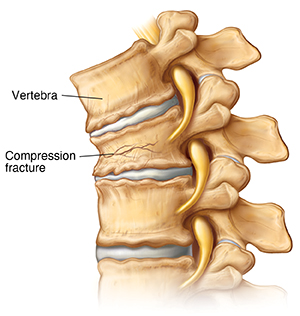
Your spine stretches from the base of your skull to your tailbone. It's composed of 33 bones (vertebrae) stacked on top of one another. These bones are strong enough to support the weight of your upper body. But certain injuries can damage 1 or more of the vertebrae and cause them to collapse. A collapsed bone in your spine is known as a compression fracture.
As you age, your bones lose calcium. This can lead to bone loss (osteopenia) or osteoporosis. This raises the risk for compression fractures and other fractures, such as in the hip.
What to expect in the ER
A healthcare provider will ask about your health history and examine you. In some cases, you may have X-rays. You may have other tests, such as a CT scan or MRI. These tests can give detailed images of your bones and spinal cord.
Treatment
Treatment will depend on the type and cause of the fracture. You will be given medicine for pain. Severe fractures or those that cause nerve problems may need surgery. Many compression fractures mend on their own.
Follow-up
As you improve, you may be given exercises to strengthen your bones. You may also need a special type of X-ray called a DEXA scan (dual-energy X-ray absorptiometry). This measures bone mineral density and bone loss. If the DEXA shows your bone density is lower than expected for your age, it means you have a risk for osteoporosis and bone fractures.
If you have osteoporosis, your provider may prescribe a medicine to treat it. Sometimes you may have pain even after the bone has healed. In that case, your provider will discuss your options.
Causes of compression fracture
Many compression fractures result from osteoporosis. This disease thins and weakens your bones so they can't withstand normal pressure and are more likely to break. Trauma from a car accident or hard fall can fracture even healthy vertebrae. In rare cases, a tumor in the bone may be the cause of a fracture. Sometimes vertebrae may fracture for unknown reasons.
When to call 911
Call
-
Can't move immediately after the incident. Keep the person still. Don't move the head or neck. Place heavy towels or rolled sheets on both sides of the neck. Or hold the head and neck still to prevent movement.
-
Loss of control over bowels or bladder
-
Numbness or weakness
-
High fever
-
Unexplained back pain in a person with cancer



