What is cubital tunnel syndrome?
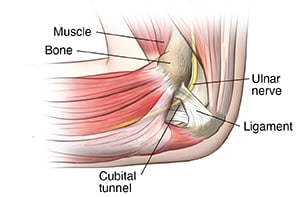
Cubital tunnel syndrome happens when the ulnar nerve, which passes through the cubital tunnel (a tunnel of muscle, ligament, and bone) on the inside of the elbow, becomes inflamed, swollen, and irritated.
Cubital tunnel syndrome causes pain that feels a lot like the pain you feel when you hit the "funny bone" in your elbow. The "funny bone" in the elbow is actually the ulnar nerve, a nerve that crosses the elbow. The ulnar nerve starts in the side of your neck and ends in your fingers.
What causes cubital tunnel syndrome?
Cubital tunnel syndrome may happen when a person bends the elbows often (when pulling, reaching, or lifting), leans on their elbow a lot, or has an injury to the area.
Arthritis, bone spurs, and previous fractures or dislocations of the elbow can also cause cubital tunnel syndrome.
In many cases, the cause is not known.
What are the symptoms of cubital tunnel syndrome?
The most common symptoms of cubital tunnel syndrome include:
- Numbness and tingling in the hand or ring and little finger, especially when the elbow is bent.
- Numbness and tingling at night.
- Hand pain.
- Weak grip and clumsiness due to muscle weakness in the affected arm and hand.
- Aching pain on the inside of the elbow.
The symptoms of cubital tunnel syndrome may seem like other health conditions or problems, including golfer's elbow (medial epicondylitis). Always see a doctor for a diagnosis.
How is cubital tunnel syndrome diagnosed?
In addition to a complete medical history and physical exam, diagnostic tests for cubital tunnel syndrome may include:
- Nerve conduction test. This test measures how fast signals travel down a nerve to check to see if the nerve is compressed or constricted.
- Electromyogram. This test checks nerve and muscle function and may be used to test the forearm muscles controlled by the ulnar nerve. If the muscles don't work the way they should, it may be a sign that there is a problem with the ulnar nerve.
- X-ray. This is done to look at the bones of the elbow and see if you have arthritis or bone spurs in your elbow.
How is cubital tunnel syndrome treated?
The most effective treatment for cubital tunnel syndrome is stopping the activity that is causing the problem. Treatment may include:
- Resting and stopping any activity, such as bending the elbow, that makes the condition worse.
- A splint or foam elbow brace worn at night (to limit movement and reduce irritation).
- Using an elbow pad (to protect against chronic irritation from hard surfaces).
- Anti-inflammatory medicines (such as ibuprofen or naproxen).
- Nerve gliding exercises.
If these treatments don't work, the doctor may talk to you about surgery.
What can I do to prevent cubital tunnel syndrome?
To prevent cubital tunnel syndrome:
- Keep your arms flexible and strong.
- Don't rest on your elbows, especially on a hard surface.
- Warm up before exercising or using your arms for sports or other repetitive movements.
When should you contact your doctor?
Call your doctor if you have:
- Pain or trouble moving that affects your regular daily activities.
- Pain doesn't get better or gets worse with treatment.
- Numbness, tingling, or weakness in the arm or hand.
Key points about cubital tunnel syndrome
- Cubital tunnel syndrome is a problem with the ulnar nerve, which passes through the inside of the elbow. It causes pain that feels a lot like the pain you feel when you hit the "funny bone" in your elbow.
- Cubital tunnel syndrome may happen when a person often bends the elbows, leans on their elbow a lot, or has an injury to the area. Arthritis, bone spurs, and previous fractures or dislocations of the elbow can also cause it. In many cases, the cause is not known.
- The most common symptoms of cubital tunnel syndrome are numbness, tingling, and pain in the hand or the ring and little finger, especially when the elbow is bent.
- Cubital tunnel syndrome can be treated with rest and medicines to help with pain and inflammation. Exercises may help too. In some cases, surgery may be done.
Next steps
Tips to help you get the most from a visit to your doctor:
- Know the reason for your visit and what you want to happen.
- Before your visit, write down questions you want answered.
- Bring someone with you to help you ask questions and remember what your doctor tells you.
- At the visit, write down the name of a new diagnosis and any new medicines, treatments, or tests. Also write down any new instructions your doctor gives you.
- Know why a new medicine or treatment is prescribed and how it will help you. Also know what the side effects are.
- Ask if your condition can be treated in other ways.
- Know why a test or procedure is recommended and what the results could mean.
- Know what to expect if you do not take the medicine or have the test or procedure.
- If you have a follow-up appointment, write down the date, time, and purpose for that visit.
- Know how you can contact your doctor if you have questions, especially after office hours or on weekends and holidays.
Online Medical Reviewer: Rahul Banerjee MD
Online Medical Reviewer: Raymond Turley Jr PA-C
Online Medical Reviewer: Stacey Wojcik MBA BSN RN
Date Last Reviewed: 09/01/2025
© 2000-2026 The StayWell Company, LLC. All rights reserved. This information is not intended as a substitute for professional medical care. Always follow your healthcare professional's instructions.


