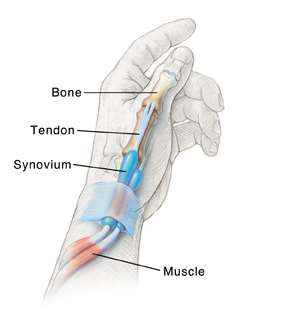
De Quervain tenosynovitis is inflammation of tendons and synovium on the thumb side of the wrist. Tendons are fibers that attach muscle to bone. Synovium is a slick membrane that helps tendons move. Movements done over and over can irritate and inflame these tissues. This can cause pain when you touch or grasp objects, turn or twist your wrist, or make a fist. You may also have pain and swelling near the base of the thumb or numbness along the back of your thumb and index finger. You may also feel the thumb catch or snap when you move it.
Treatment will depend on how bad the symptoms are. It can often be treated with medicines, injections, splinting, and home care. If your case is severe, you may be referred to a specialist to talk about surgery.
Home care
Your health care provider may prescribe medicines to relieve pain and reduce inflammation. A steroid medicine may be injected near the tendons. This reduces swelling and pain. The health care provider may also suggest taking over-the-counter medicines, such as ibuprofen or naproxen. These help reduce inflammation. Take all medicines only as directed.
The following are general care guidelines:
-
Prevent repetitive movements of your wrist and thumb.
-
Note any activity that causes pain or swelling. If possible, prevent or limit that activity.
-
Put a cold pack on your wrist. To make an ice pack, put ice cubes in a plastic bag that seals at the top. Wrap the bag in a clean, thin towel or cloth. Hold this to your wrist for up to 20 minutes at a time. Don't put ice directly on the skin.
-
Your health care provider may put a splint on the wrist or thumb to hold it still. Use the splint as you have been instructed. In some cases, you may need to use a splint 24 hours a day for 4 to 6 weeks. This will allow the wrist and thumb to heal.
Follow-up care
Follow up with your health care provider as advised. You may need more treatment if your injury is severe or if your symptoms don't get better. This additional treatment may include local injections, physical therapy, or surgery.
When to call your doctor
Contact your health care provider right away if:
-
You have increased pain or swelling.
-
You have fever, chills, redness, warmth, or drainage.
-
Your symptoms get worse after taking medicine.
-
The pain spreads farther down the thumb or into the forearm.
-
Your pain continues to get in the way of daily life.
Online Medical Reviewer: L Renee Watson MSN RN
Online Medical Reviewer: Raymond Turley Jr PA-C
Online Medical Reviewer: Thomas N Joseph MD
Date Last Reviewed: 02/01/2025
© 2000-2026 The StayWell Company, LLC. All rights reserved. This information is not intended as a substitute for professional medical care. Always follow your healthcare professional's instructions.


