Types

Osteoporosis: Understanding Bone Loss

Choose a preferred language

The body has a natural system for maintaining bone. Understanding this system can help you learn how to maintain your bones.


A balanced system supports the body

The body is always losing (resorbing) and making bone. This process is called remodeling. Bone-resorbing cells take bone apart. They do this so the minerals can be used to repair an injury or make new bone. Bone-making cells form new bone using calcium and other minerals. These minerals come from the food you eat. When this bone-making system is in balance, the same amount of bone is built and resorbed.
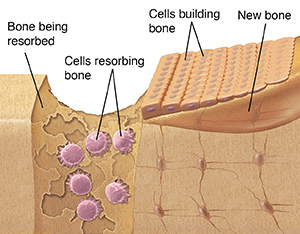
Diagram of normal bone growth showing three different types of bone cells.


An unbalanced system can't give support

Changes in hormone levels, activity, medicines, or diet can affect the bone-making system. When the system gets out of balance, the amount of bone lost is greater than the amount of bone made. This can cause osteopenia. It is when bone starts to become less dense. Left untreated, bone loss gets worse, leading to osteoporosis. Weak bones can’t support the body. In fact, they can break (fracture) just from the weight of your body. This often happens in bones of the spine (vertebrae). When vertebrae fracture, parts of the spine compress. This causes the back to bend or hump over, and it can also cause back pain.
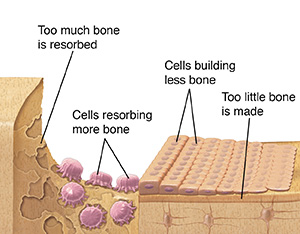

Bone with osteoporosis showing osteoblasts not making enough bone and osteoclasts resorbing too much.

© 2000-2026 The StayWell Company, LLC. All rights reserved. This information is not intended as a substitute for professional medical care. Always follow your healthcare professional's instructions.

Make an Appointment

Make an Appointment

Find a Doctor

Find a Doctor

Find a Location

Find a Location

Related Services

Orthopedics Center

Related Articles
Read article
Orthopedics
Broken Kneecap

A broken kneecap causes pain, swelling, and sometimes bruising. Depending on how severe the fracture is, it may take about 4 to 6 weeks to heal. Learn how to care for yourself at home.

Read article
Orthopedics
Hip Dislocation

A hip dislocation happens when the femur pops out of its socket. Learn what kind of care is needed.

Read article
Orthopedics
Open Toe Fracture

A toe fracture causes local pain, swelling, and bruising. A nearby open injury, such as a cut, puncture, or deep scrape, increases the risk of infection in the skin and bone. Antibiotics are used to lower the risk of infection.

Read article
Orthopedics
Understanding Multidirectional Shoulder Instability

The shoulder is the most flexible joint in the body. But it does have limits. If the joint is pushed past these limits, the shoulder joint may move too much. This is called shoulder instability.


