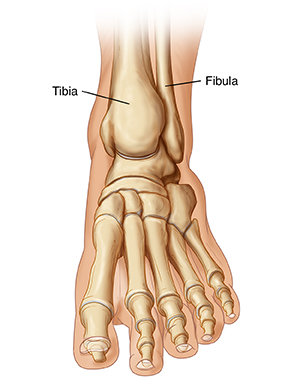
A pilon fracture is a type of break of the shinbone (tibia) that occurs near the ankle. In most cases, it includes breaks in both the tibia and fibula of the lower leg. The lower ends of these bones make up part of the ankle.
What causes pilon fracture of the ankle?
A high-energy impact most often causes a pilon fracture. Common causes include:
-
A fall from high up.
-
Motor vehicle accident.
-
Skiing accident.
The force from the impact often drives one of the foot bones (talus) into the tibia. The tibia and often the fibula break. Other injuries may also happen during the impact.
Symptoms of pilon fracture of the ankle
A pilon fracture can cause symptoms such as:
-
Swelling of the leg and ankle.
-
Bruising of the leg and ankle.
-
Severe pain to the touch.
-
Not being able to put weight on your foot.
-
Having an ankle that looks crooked.
Diagnosing pilon fracture of the ankle
Your health care provider will ask about your symptoms and your health history. You’ll have a physical exam to check for other injuries. Your provider will carefully check your lower leg and ankle. They may push on different areas to see if they hurt to the touch. They'll also look for swelling and will make sure blood is flowing normally to your foot and ankle.
You'll likely need X-rays of your leg, ankle, and foot to check for broken bones. You may also need a CT scan to check your injury in more detail.
Treatment for pilon fracture of the ankle
If the bones of your tibia still line up correctly, you will have treatments such as:
-
A splint to hold your ankle in place.
-
A cast or boot, once the swelling goes down.
-
Pain medicine.
If the bones of your pilon fracture are out of place, you'll likely need surgery. Your surgery may wait until the swelling has gone down. While you wait, you may need to have a splint or an external fixator.
During surgery, the bones are lined up correctly. They may also be held in place with special plates and screws. This is called internal fixation. If the fixation is out of the skin, it is called external fixation. The plates and screws may be removed weeks or months later. After your leg has healed a bit, you may start physical therapy exercises. You may have a removable brace or splint. This can be taken off during physical therapy. The exercises will help build up strength and increase your range of motion. You’ll also need to use a walker, crutches, or a cane for a few months after your injury.
Follow all of your health care provider’s instructions carefully. They may tell you to:
-
Take a prescription blood thinner to prevent blood clots.
-
Not take certain over-the-counter medicines for pain that may interfere with bone healing.
-
Eat foods high in calcium and vitamin D to help with bone healing.
-
Not smoke, because it can delay bone healing.
Possible problems of pilon fracture of the ankle
Possible problems from a pilon fracture can include:
-
Stiffness in your joint, which physical therapy may help.
-
Ankle arthritis that causes chronic ankle pain.
-
Infection, which may need treatment with antibiotics or follow-up surgery.
-
A bone that doesn't heal correctly. It may need follow-up surgery.
-
Pain from the plates and screws used in your surgery.
-
Problems with wound healing.
-
Blood vessel or nerve damage from the pilon fracture.
-
Blood clot.
When to call your doctor
Contact your health care provider if you have:
-
Fever of 100.4°F (38°C) or higher, or as directed by your provider.
-
Chills.
-
Redness, swelling, or fluid leaking from your incision that gets worse.
-
Pain that gets worse.
-
Leg that feels numb.
-
Sudden, severe symptoms like shortness of breath. (Tell your provider right away.)
Online Medical Reviewer: Kenny Turley PA-C
Online Medical Reviewer: L Renee Watson MSN RN
Online Medical Reviewer: Thomas N Joseph MD
Date Last Reviewed: 02/01/2025
© 2000-2026 The StayWell Company, LLC. All rights reserved. This information is not intended as a substitute for professional medical care. Always follow your healthcare professional's instructions.


