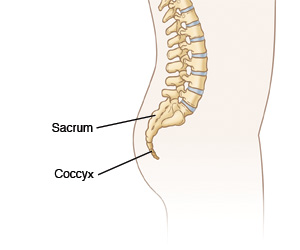
The tailbone, or coccyx, is at the bottom of your spine. Although uncommon, it's possible to break (fracture) this bone when you fall and land in a seated position. Usually, this happens when you have a backward fall on a hard surface, such as a slippery floor or ice. A direct blow to the tailbone, such as one that might occur during contact sports, can also cause it to fracture. Your risk of tailbone fracture increases if you suffer from osteoporosis.
This injury takes about 4 to 6 weeks to heal. Until then, it will be painful to sit, get up from a seated position, and have bowel movements.
Home care
Unlike other broken bones, a broken tailbone cannot be put in a cast to immobilize it.
-
Lying down or standing will often be more comfortable than sitting. When you must sit, use a doughnut pillow. The hole in the center will take pressure off your tailbone. This pillow is sold at most pharmacies or surgical and orthopedic supply stores. You can also make a doughnut-shaped pillow using a 4-inch foam pad with the center cut out. Other cushion options include U-shaped cushions or a cushion with a wedge-shaped cutout.
-
Apply an ice pack over the injured area for not more than 20 minutes. Do this every 1 to 2 hours for the first 24 to 48 hours. Keep using ice packs as needed to ease pain and swelling. To make an ice pack, put ice cubes in a plastic bag that seals at the top. Wrap the bag in a clean, thin towel or cloth. Never put ice or an ice pack directly on the skin.
-
You may use over-the-counter pain medicine unless another pain medicine was prescribed. Talk with your health care provider before using these medicines if you have chronic liver or kidney disease, or ever had a stomach ulcer or digestive tract bleeding.
-
Don't sit for hours at a time. If you spend a lot of time at a computer or desk, using a "standing desk" for work can be helpful during the recovery period.
-
While sleeping, if possible:
-
Use a firm mattress.
-
Sleep on your side with a pillow between your knees.
-
Lie on your belly to take pressure off the tailbone.
-
-
Your provider might recommend:
-
Exercises to strengthen the hip and core muscles that support the lower spine.
-
Pelvic floor physical therapy, if you have substantial pain in the adjacent paracoccygeal muscles.
-
-
Keep your stools soft to prevent pain when having a bowel movement. Unless another medicine was prescribed, try the following:
-
If you are constipated, use over-the-counter laxatives. Ask your pharmacist for advice about mild or strong medicines.
-
If you aren't constipated, use over-the-counter stool softeners to make passing stool less painful. Your pharmacist can suggest options. Drinking plenty of water and adding fiber to your diet or using fiber supplements are long-term solutions to keep your stools soft and prevent constipation. Ask your pharmacist to advise a fiber supplement.
-
Follow-up care
As your pain level improves, you may begin some light activities and gradually increase them. Sitting in proper posture will help. Until you are fully recovered:
-
Continue to avoid sitting for long periods of time.
-
Don't sit on hard surfaces.
-
Keep using the doughnut cushion when sitting.
Follow up with your health care provider if your symptoms don't improve after 1 week.
If X-rays were taken, you will be told of any new findings that may affect your care.
When to get medical advice
Contact your health care provider right away if your pain becomes worse or spreads to your legs.
Call 911
Call
-
Sudden tingling, weakness, or numbness in one or both legs.
-
Loss of control over bowels or bladder, or numbness in the groin area.
Online Medical Reviewer: Marianne Fraser MSN RN
Online Medical Reviewer: Raymond Turley Jr PA-C
Online Medical Reviewer: Vinita Wadhawan Researcher
Date Last Reviewed: 12/01/2024
© 2000-2026 The StayWell Company, LLC. All rights reserved. This information is not intended as a substitute for professional medical care. Always follow your healthcare professional's instructions.


