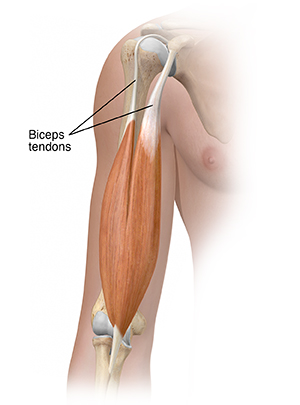
A tendon is a strong band of tissue that connects muscle to bone. The biceps muscle is in the front of the upper arm. It helps with movements such as bending the elbow or raising the arm. The upper end of the biceps muscle is called the proximal end. It has two tendons called the long head and the short head. These tendons attach the muscle to the bones in the shoulder. Biceps tendonitis occurs when either of these tendons is irritated or red and swollen (inflamed). Most cases involve the long head.
Causes of biceps tendonitis
Causes can include:
-
Wear and tear of the tendon from aging or normal use over time.
-
Overuse of the tendon from sports or work activities, especially those that involve repeated overhead movements.
-
Injury to the tendon from a fall or other accident.
-
Other problems in the shoulder, such as shoulder impingement or a rotator cuff tear.
Symptoms of biceps tendonitis
Common symptoms include:
-
Pain in the front of the shoulder that may also travel down the upper arm bone. The pain may be worse with overhead lifting or activity, and at night.
-
Swelling in the shoulder.
-
Clicking or catching sensation when using the arm and shoulder.
-
Trouble moving the arm and shoulder.
-
Weakness.
Treating biceps tendonitis
Treatment for biceps tendonitis may include:
-
Resting the arm and shoulder. This involves limiting certain movements, such as reaching above the head or raising the arm. These can slow healing and make symptoms worse. You may also need to limit certain sports and types of work for a time.
-
Cold therapy. This involves using items such as ice packs to help relieve symptoms. Cold can help reduce pain and swelling.
-
Medicines. These help relieve pain and swelling. NSAIDs (nonsteroidal anti-inflammatory drugs) are the most common medicines used. Medicines may be prescribed or bought over the counter. They may be given as pills, or they may be applied to the skin in the form of a gel, cream, or patch.
-
Injections of medicine into the injured area. These help relieve pain and swelling.
-
Physical therapy and exercises. These help improve strength and range of motion in the arm and shoulder.
Possible complications
-
If the tendon isn’t given time to heal, symptoms may worsen. Also, the tendon may tear (rupture).
-
If the tendon ruptures or doesn’t get better with treatment, your healthcare provider may recommend surgery. This most often involves repairing and reattaching the tendon.
When to contact your doctor
Contact your doctor right away if you have:
-
A fever of 100.4°F (38°C) or higher, or as directed by your doctor.
-
Chills.
-
Symptoms that don’t get better with treatment, or that get worse.
-
Weakness or instability in the arm or shoulder.
-
Sudden sharp pain, bruising, swelling, popping or snapping sensation, or bulge in the upper arm or shoulder.
-
New symptoms.
Author: Yang, Sue
Online Medical Reviewer: Stacey Wojcik MBA BSN RN
Online Medical Reviewer: Thomas N Joseph MD
Date Last Reviewed: 05/01/2025
© 2000-2026 The StayWell Company, LLC. All rights reserved. This information is not intended as a substitute for professional medical care. Always follow your healthcare professional's instructions.


