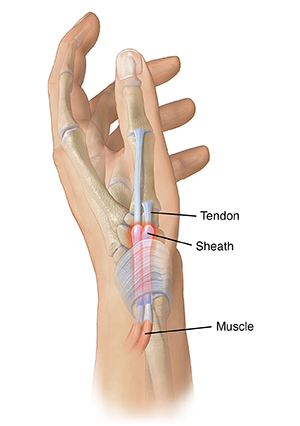
De Quervain tenosynovitis is a condition that can cause wrist and thumb pain. Tendons connect muscles in your wrist and forearm to the bones in your thumb. The tendons have a protective cover (sheath). The sheath’s lining makes a fluid that lets the tendons slide easily when you straighten your wrist and thumb. If any of these tendons are irritated or injured, they can become swollen and inflamed. This is called de Quervain tenosynovitis.
How to say it
di-kwer-VAYN tehn-oh-sin-oh-VI-tihs
What causes de Quervain tenosynovitis?
This condition is most often caused from overuse. For example, making the same wrist motions over and over can irritate the tendons. This includes doing things like unscrewing jar lids or grasping a tool. Activities such as typing, playing racquet sports, knitting, and texting can also lead to the condition.
Symptoms of de Quervain tenosynovitis
You may have pain, soreness, redness, and swelling along the side of your wrist and the base of your thumb. You may feel pain when you pinch or grasp things, turn or touch your wrist, or make a fist. Your thumb may catch or make a crackling sound when you move it.
Treatment for de Quervain tenosynovitis
Treatments may include:
-
Resting the wrist and thumb. This involves limiting movements that make your symptoms worse. You also may need to stay away from certain hobbies, sports, and types of work for a time.
-
Cold packs. These help reduce pain and swelling.
-
Prescription or over-the-counter medicines. These help relieve pain and swelling. NSAIDs (nonsteroidal anti-inflammatory drugs) are the most common medicines used. Medicines may be prescribed or bought over the counter. They may be given as pills. Or they may be put on the skin as a gel, cream, or patch.
-
Splint or brace. This helps keep the thumb and wrist from moving. It also gives time for your tendons to heal.
-
Exercises or physical therapy. These help stretch, strengthen, and improve the range of motion in your wrist and thumb.
-
Shots of medicine into the area around the tendon. These often are anti-inflammatory medicines called corticosteroids. They may help ease pain and swelling.
-
Surgery. You may need surgery if other treatments don’t relieve symptoms. During surgery, the surgeon releases the sheath that surrounds the tendons. This is so the tendons can move more easily.
Possible complications of de Quervain tenosynovitis
Without proper care and treatment, healing may take longer than normal. Also, symptoms may continue or get worse. Over time, the problem may become long-term (chronic). This can make it hard to use your wrist and thumb for normal activities.
When to call your healthcare provider
Call your healthcare provider right away if you have any of these:
-
Fever of 100.4°F (38°C) or higher, or as directed by your provider
-
Chills
-
Symptoms that don’t get better with treatment, or that get worse
-
Pain, numbness, or coldness in the hand
-
New symptoms
Author: Yang, Sue
Online Medical Reviewer: Kenny Turley PA-C
Online Medical Reviewer: L Renee Watson MSN RN
Online Medical Reviewer: Raymond Kent Turley BSN MSN RN
Date Last Reviewed: 04/01/2024
© 2000-2026 The StayWell Company, LLC. All rights reserved. This information is not intended as a substitute for professional medical care. Always follow your healthcare professional's instructions.


