Frozen shoulder is a condition where the shoulder becomes painful and hard to move. The condition is sometimes called adhesive capsulitis.
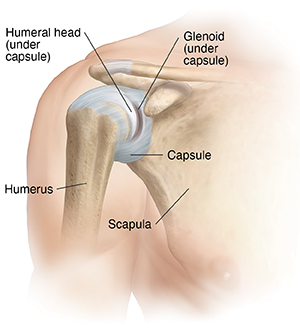
The shoulder is a joint that's made up of many parts. These parts allow you to raise, rotate, and swing your arm. The parts of a normal shoulder are:
-
Humeral head. The ball at the top of the upper arm bone (humerus).
-
Scapula. The shoulder blade.
-
Glenoid. The shallow socket on the scapula. (The humeral head rests on the glenoid.)
-
Capsule. A sheet of tough tissue that encloses the joint and joins the ball to the socket.
With frozen shoulder, the capsule becomes thick, and shrinks and pulls in (contracts). It's not clear why this happens. It may be from swelling and irritation, or from scar tissue forming. Over time, this may result in pain, stiffness, and loss of movement in the shoulder.
What causes frozen shoulder?
Experts don’t know for sure why frozen shoulder occurs. Some things can make the condition more likely. These include:
-
Being a woman
-
Being 40 to 60 years old
-
Having certain health conditions, such as diabetes or thyroid disease
-
Taking certain medicines
-
Not using the shoulder for a prolonged period of time, such as after an injury or surgery
Symptoms of frozen shoulder
Frozen shoulder typically occurs in three stages. Each stage will vary, but often lasts a few months or longer:
-
Freezing stage. The shoulder is very painful. Pain often gets worse when moving your arm and at night during sleep. The shoulder slowly becomes stiffer.
-
Frozen stage. The shoulder is very stiff and hard to move. Pain may be less than in the first stage. It may be hard to do daily tasks, such as dressing or bathing.
-
Thawing stage. Pain and stiffness slowly get better. In time, normal or almost normal use of the shoulder usually returns.
Treatment for frozen shoulder
Most cases of frozen shoulder get better, even with no treatment. Treatment is done to help speed healing and help regain as much joint movement as possible. The best course of treatment will depend on your needs. It may include 1 or more of these:
-
Prescription or over-the-counter medicines. These help relieve pain and reduce swelling. NSAIDs (nonsteroidal anti-inflammatory drugs) are the most common medicines used. Medicines may be prescribed or bought over the counter. They may be given as pills. Or they may be put on the skin as a gel, cream, or patch.
-
Stretching exercises. These help restore movement to the shoulder. You may do them on your own or under the care of a physical therapist.
-
Cortisone shots. These are given into your shoulder joint. They can’t cure frozen shoulder. But they can help give short-term relief from symptoms and allow you to do exercises without too much pain.
-
Cold packs and heat packs. These can help ease symptoms.
Keep in mind that getting better is a slow process. It can take 1 year or longer. If your shoulder doesn’t get better on its own in this time, you may need surgery. This is done to loosen the tight tissues in the shoulder joint.
When to call your healthcare provider
Call your healthcare provider right away if you have any of these:
-
Fever of 100.4°F (38°C) or higher, or as advised by your provider
-
Chills
-
Symptoms that don’t get better, or that get worse
-
New symptoms
Author: Michels, Karen
Online Medical Reviewer: Kenny Turley PA-C
Online Medical Reviewer: L Renee Watson MSN RN
Online Medical Reviewer: Raymond Kent Turley BSN MSN RN
Date Last Reviewed: 04/01/2024
© 2000-2026 The StayWell Company, LLC. All rights reserved. This information is not intended as a substitute for professional medical care. Always follow your healthcare professional's instructions.


