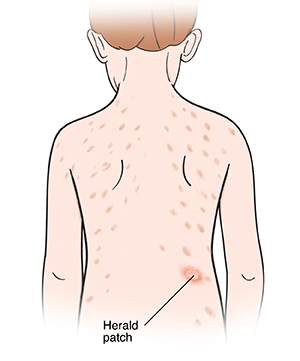
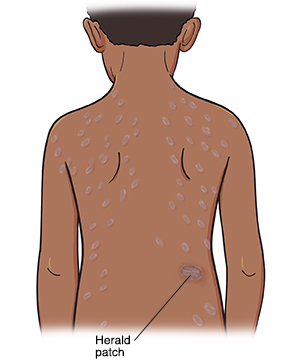
Pityriasis rosea is an itchy skin rash that appears on the back and chest. It often starts with a single, large oval patch called a herald patch. Smaller patches may appear a few days later. Children with darker skin may develop patches on their face, arms, or legs. Pityriasis rosea occurs more often in older children and teens, but anyone can get it. It can cause your child mild discomfort, but it's not a serious problem. It can easily be managed and treated at home.
What causes pityriasis rosea?
The exact cause of pityriasis rosea is unknown. It doesn’t often spread from person to person.
What are the symptoms of pityriasis rosea?
Pityriasis rosea causes a rash made up of small, oval, or round marks. The marks are scaly and pink or light brown. Sometimes the rash spreads in a Christmas-tree pattern on the back. It can also cause itching.
How is pityriasis rosea diagnosed?
Pityriasis rosea is diagnosed by how it looks. The health care provider will ask about your child’s symptoms and health history. They'll also examine your child. You'll be told if any tests are needed.
How is pityriasis rosea treated?
-
Pityriasis rosea may cause itching for 1 to 2 weeks. It usually goes away on its own within 6 to 8 weeks. Most children get better without treatment.
-
If needed, give your child over-the-counter (OTC) antihistamine medicine to ease itching. These types of medicine may cause sleepiness.
-
Put an OTC medicine such as hydrocortisone cream on the skin to ease itching. Wash your hands with clean, running water and soap before and after you apply the medicine.
-
Use lukewarm water for showers and baths. Try not to get overheated.
-
Talk with your health care provider about any severe itching. Some prescription medicines may be helpful.
When to call the health care provider
Call your child's health care provider if your child has:
-
A rash that gets worse or becomes painful.
-
Itching that doesn't respond to home treatment.
What are the long-term concerns?
After healing, your child’s skin may look darker or lighter in the affected areas. This color change will fade over time.
Featured in
Online Medical Reviewer: Chelsey Schilling BSN RN
Online Medical Reviewer: Tara Novick BSN MSN
Online Medical Reviewer: Vinita Wadhawan Researcher
Date Last Reviewed: 08/01/2016
© 2000-2026 The StayWell Company, LLC. All rights reserved. This information is not intended as a substitute for professional medical care. Always follow your healthcare professional's instructions.


