Warts are small growths on the skin. They can appear anywhere on the body and be any size. Warts are usually harmless. But they may bother your child if they appear on areas such as the face or hands. Warts can often be treated at home. Talk with your child’s doctor if you or your child have questions or concerns.
What causes warts?
Warts are caused by the human papillomavirus (HPV). This virus can spread between people. But you can be exposed to the virus and not get warts.
What are common types of warts?
-
Common warts. These have a rough, bumpy look (like cauliflower). They often appear on the hands and other parts of the body.
-
Flat warts. These are raised, with smooth, flat tops. They often appear in clusters on the face and other parts of the body.
-
Plantar warts. These appear on the soles of the feet. They can be very painful.
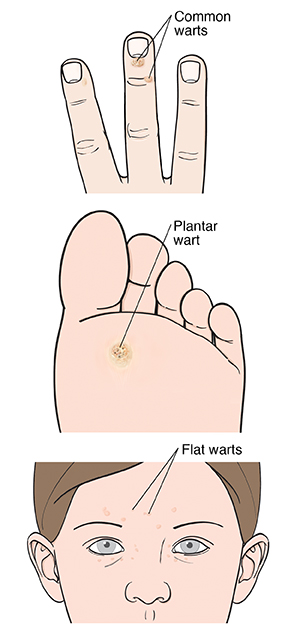
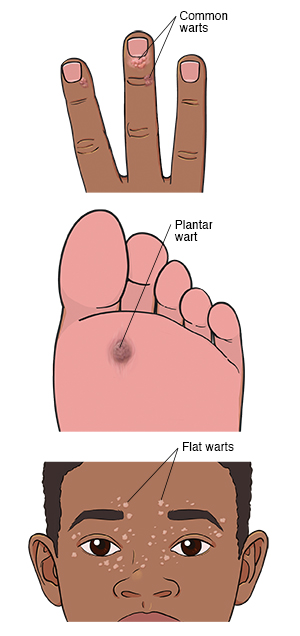
Genital warts are also a common type of wart. But they are not common in children. Genital warts appear on the genitals and are a sexually transmitted infection caused by a type of HPV. If a child has genital warts, they must be evaluated for possible sexual abuse.
How are warts diagnosed?
Warts are diagnosed by how they look and by their location. To get more information, the doctor will ask about your child’s symptoms and health history. The doctor will also examine your child. You will be told if any tests are needed. The doctor will refer your child to a skin doctor (dermatologist) or foot doctor (podiatrist), if needed.
How are warts treated?
Warts generally go away on their own, but the amount of time varies and may range from weeks to years. Speak with the doctor about choices to treat warts. These can include:
-
Medicated creams. These can often be bought over the counter or are prescribed by the doctor. Use a pumice stone to remove dead skin above the wart before applying any medicine. A foot soak can also help soften the wart.
-
Special cushions. These can be applied to the wart to ease pressure and reduce pain.
-
Occlusive therapy. Duct tape may reduce the time it takes for a wart to go away. Duct tape should be placed over the wart as instructed by the doctor.
-
Office procedures to remove a wart. These include surgery, removal by freezing (cryotherapy), or removal by burning (electrocautery).
It’s important to remember that even after treatment, it may take about 4 weeks to see results. Warts may also regrow if the virus is still in the body.
When to contact the doctor
Contact your child's doctor right away if your child has:
-
A wart that doesn’t respond to treatment.
-
A plantar wart that causes ankle, foot, or leg pain.
-
Signs of infection around a wart (pus, drainage, or bleeding).
Featured in
Online Medical Reviewer: Dan Brennan MD
Online Medical Reviewer: L Renee Watson MSN RN
Online Medical Reviewer: Michael Lehrer MD
Date Last Reviewed: 06/01/2025
© 2000-2026 The StayWell Company, LLC. All rights reserved. This information is not intended as a substitute for professional medical care. Always follow your healthcare professional's instructions.


