Your right side may hurt so much that you call your doctor. Or maybe you go straight to the hospital emergency room. After your evaluation, your doctor may decide that you have appendicitis. If so, you may need surgery. Your doctor will admit you to the hospital or take you right to the operating room.
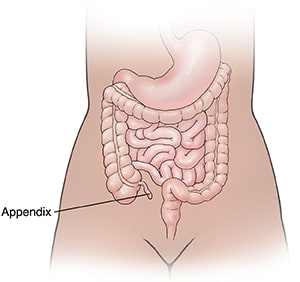
Your experience
You may get fluids and antibiotics through an I.V. (intravenous) line placed in your hand or arm. Tell your doctor if you're allergic to any antibiotics or other medicines. Before surgery, an anesthesiologist or nurse anesthetist will talk with you. They'll give you medicine (general anesthesia) just before your appendectomy. This keeps you pain-free and lets you sleep during the surgery.
During surgery
The goal of surgery is to remove your appendix safely. In most cases, the surgery lasts about 30 minutes to an hour. If your appendix has burst, bacteria will be released into the belly (abdominal) cavity. This complication may make the surgery take longer. Your surgeon may use open surgery or laparoscopic surgery to reach your appendix. Your surgeon will discuss which is best for you:
- Open surgery. Your surgeon makes a large cut (incision) in your lower right side. They make a bigger incision if your appendix has burst.
- Laparoscopic surgery. Your surgeon makes from 2 to 4 small incisions. One is near your belly button. The others are in other parts of your stomach. Your surgeon puts a thin tube with a camera attached (laparoscope) through one of the incisions. The camera shows the inside of your belly on a screen. This image helps guide the surgery. Your surgeon puts surgical tools into the other incisions.
Sometimes if the appendix has burst and a pocket of infection has formed, this will be drained. Antibiotics are given for some time (perhaps weeks) before the appendix is removed.
Finishing the surgery
In most cases, the surgeon closes the entire incision with stitches or staples. Your surgeon may place a short-term (temporary) drain in the wound or in your belly. This helps cure or prevent infection. If your appendix burst, your surgeon may leave the outer layers of your incision open. Leaving the skin open prevents infection from forming under the skin. It may heal on its own. Or it may be closed about 5 days later.
Recovery
Most people recover quickly after an appendectomy. You'll likely be in the hospital for 1 to 2 days. If your appendix burst, you may stay longer. After you return home, plan on a follow-up visit to the doctor in 1 to 2 weeks.
In the hospital
In most cases, you'll drink fluids and walk on the day of your surgery. You'll also be given pain medicine as needed. To help keep your lungs clear, a doctor may teach you how to do cough and deep breathing exercises.
Back at home
To help control pain from surgery, take your medicines as directed. Don't do any strenuous activity, heavy lifting, or driving until your surgeon says it is okay. As instructed, slowly go back to your normal activities in 7 to 10 days. If you're constipated, take fiber or a stool softener.
Risks and possible complications
Risks and complications can include the following:
- Infection or bleeding from the incision site
- Infection or swelling in the belly, or stool leakage
- Delayed return of bowel or intestinal function (bowel ileus) or bowel blockage
- Problems from anesthesia
Contact your doctor
Contact your doctor right away if you have any of the following:
- Swelling, oozing, pain that gets worse, or abnormal redness around the incision
- Fever of
100.4°F (38°C) or higher, or as directed by your doctor - Belly pain that gets worse
- Severe diarrhea, bloating, or constipation
- Upset stomach (nausea) or vomiting
- Trouble breathing or shortness of breath
- Leg swelling
Featured in
Online Medical Reviewer: Heather M Trevino BSN RNC
Online Medical Reviewer: Robyn Zercher FNP
Online Medical Reviewer: Ronald Karlin MD
Date Last Reviewed: 04/01/2024
© 2000-2026 The StayWell Company, LLC. All rights reserved. This information is not intended as a substitute for professional medical care. Always follow your healthcare professional's instructions.


