You may be trying to pass a kidney stone. A urine strainer is used to collect a kidney stone from the urine stream.
Collection method
-
Each time you urinate, do so in a jar.
-
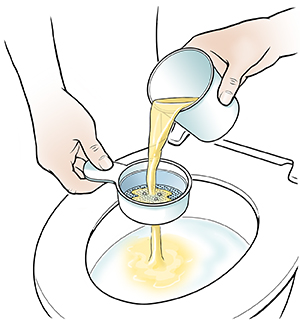
Pour the urine from the jar through the strainer and into the toilet.
-
Save any particles or stones.
-
Wash your hands when you are done.
-
Keep doing this until
24 hours after your pain stops. By then, if there was a kidney stone, it should have passed out of your bladder. Some stones dissolve into sandlike pieces. These pass right through the strainer. In that case, you won't ever see a stone.
Caution: Being pain-free does not confirm that the stone has passed. If you have been diagnosed with blockage from a stone, its passage must be confirmed. This can be done by capturing the stone in a urine strainer. Or it can be confirmed with an X-ray or ultrasound. Follow up with your doctor as advised.
Follow-up care
Save any stone that you find in a small container. Bring it to your doctor for analysis. This will help your doctor find out what type of stone was passed. This information may be used to help prevent some types of stones from forming again. You may be advised to take medicine to reduce the risk of future stones. Your doctor may want to do more blood and urine tests to help find the proper prevention steps. Follow your doctor's advice on fluid intake, possible diet changes, and follow-up appointments.
When to get medical advice
Contact your doctor right away if symptoms of a kidney stone return, such as:
-
Sharp pain in your lower belly, side, or lower back.
-
A fever of 100.4°F (38°C) or higher, or as directed by your doctor.
-
Vomiting.
-
Bloody or bad-smelling urine.
-
Pain that increases or gets worse with urination.
Online Medical Reviewer: Melinda Murray Ratini DO
Online Medical Reviewer: Raymond Kent Turley BSN MSN RN
Online Medical Reviewer: Vinita Wadhawan Researcher
Date Last Reviewed: 04/01/2025
© 2000-2026 The StayWell Company, LLC. All rights reserved. This information is not intended as a substitute for professional medical care. Always follow your healthcare professional's instructions.


