Percutaneous nephrolithotomy may be done before, after, or instead of other treatments. This procedure is done if you are not able to pass larger stones on your own. If you need this procedure, your doctor will discuss its risks and possible complications. They will tell you how to prepare. They will also discuss the medicine (anesthesia) given to you during the procedure. It will keep you comfortable and pain-free.
Nephrolithotomy with incision
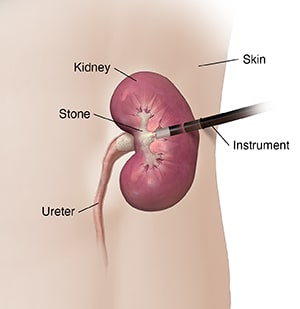
Percutaneous nephrolithotomy is a procedure that removes larger stones through a small incision in your side. Your doctor places a viewing tube through your incision. The stone is sighted and either removed or shattered with a special device, if needed, and then removed. Afterward, you'll briefly have a small soft tube in your incision. This tube carries urine away from your kidney and out of your body.
Your recovery
You may spend 1 to 3 days in the hospital. The tube in your side will be removed during or shortly after your hospital stay. You'll have a follow-up visit in 3 months to check that your stone is gone. Later visits and testing will help your doctor spot new stones if any form.
When to call your doctor
Contact your doctor right away if you have:
- Sudden pain or flank pain.
- A fever of 100.4°F (38°C) or higher, or as directed by your doctor.
- Nausea that lasts for days.
- Heavy bleeding when you urinate or through your drainage tube.
- Swelling or redness around your incision.
- New symptoms or symptoms that get worse.
Online Medical Reviewer: Raymond Kent Turley BSN MSN RN
Online Medical Reviewer: Rita Sather RN
Online Medical Reviewer: Walead Latif MD
Date Last Reviewed: 09/01/2025
© 2000-2026 The StayWell Company, LLC. All rights reserved. This information is not intended as a substitute for professional medical care. Always follow your healthcare professional's instructions.


