Each of your testicles makes sperm (male reproductive cells). Sperm travel from the testicles to the penis through one of two tubes (vas deferens). On the way, sperm mix with other fluids to form semen, which leaves the body during ejaculation. During a vasectomy, each vas deferens is cut. This prevents sperm from leaving the body. This means that after a vasectomy, your sperm won't be able to fertilize an egg. A vasectomy can often be reversed, restoring the flow of sperm out of the body.
Some pregnancies happen in the first few months after a reversal. But it may takes at least 4 months. Pregnancy rates depend on how soon the reversal is done after a vasectomy. The sooner the reversal, the faster the sperm return and the higher the pregnancy rate.
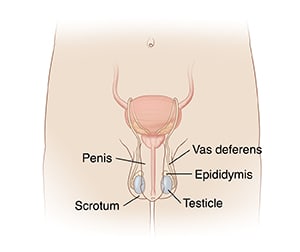
How the procedure works
During a vasectomy reversal, the two cut ends of each vas deferens are stitched back together. With the sperm pathways restored, sperm can again travel through the vas deferens and leave the body during ejaculation. Your sperm may then be able to fertilize an egg, which may result in a pregnancy.
Getting ready for the procedure
You'll be given instructions to get ready for the vasectomy reversal. You'll be asked to sign a consent form. Read the form carefully and ask any questions you have before you sign. Tell your doctor about any medicines you take. This includes all prescription and over-the-counter medicines (including aspirin), vitamins, herbs, and other supplements or drugs. You may be asked to stop taking some or all of these. On the day of your procedure, bring clean cotton briefs or an athletic support with you.
During the procedure
You'll be given medicine to keep you pain-free. You may be awake and relaxed during the procedure. Or you may be completely asleep. After this medicine takes effect:
- A cut (incision) is made in your scrotum.
- The cut ends of each vas deferens are lifted out and examined. A part of each cut end may be removed.
- The end closer to the testicles is cut until fluid flows freely. This fluid may be looked at under a microscope to see if it contains sperm.
- The two cut ends are stitched together. If needed, the vas deferens may be attached directly to the epididymis, which is the tubular tissue behind the testicle.
- After the cut ends of each vas deferens are reconnected, the incisions in the scrotum are stitched closed.
After the procedure
You may need to stay in the hospital or surgery center for several hours. When it's time to go home, have an adult family member or friend drive you. After you're home:
- Take medicine as directed to ease any pain.
- To reduce the chance of swelling, stay off your feet as much as you can for the first day.
- Place an ice pack (wrapped in a thin towel) on your scrotum for short amounts of time for the first 24 hours. This helps reduce swelling. To make an ice pack, put ice cubes in a plastic bag that seals at the top. Wrap the bag in a thin towel or cloth. Never put ice or an ice pack directly on the skin.
- Wear an athletic support or snug cotton briefs for extra support.
- Follow your doctor's instructions for showering and bathing.
- Ask your doctor when it's okay to have sex.
- Don't do any heavy lifting or exercise for at least 2 weeks. Ask your doctor when you can return to work.
Risks and possible complications
- Risks linked to anesthesia.
- Infection. Symptoms include fever, chills, drainage from the incision site, and pain.
- Internal bleeding of the scrotum. Symptoms include increasing pain, excessive swelling, a large black-and-blue area, or a growing lump.
- The procedure fails to restore fertility.
Featured in
Online Medical Reviewer: Marianne Fraser MSN RN
Online Medical Reviewer: Raymond Kent Turley BSN MSN RN
Online Medical Reviewer: Rita Sather RN
Date Last Reviewed: 08/01/2023
© 2000-2026 The StayWell Company, LLC. All rights reserved. This information is not intended as a substitute for professional medical care. Always follow your healthcare professional's instructions.


