Hydronephrosis is when your kidneys fill with too much urine and swell up. It's caused by a problem in the urinary tract that stops urine from draining normally.
How to say it
HI-droh-neh-FRO-siss
How hydronephrosis happens
Urine usually flows from the kidneys down through the ureters, bladder, and out of the body through the urethra. Hydronephrosis occurs when something blocks this flow of urine.
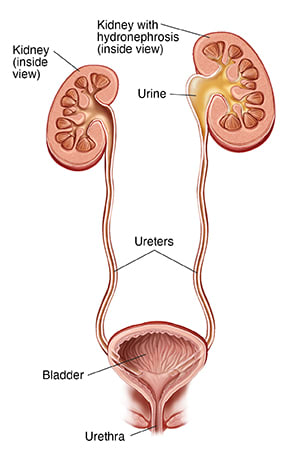
What causes hydronephrosis?
The condition has many possible causes. They include:
- Narrowing (stricture) in a tube that drains urine (ureter or urethra).
- Kidney stones.
- Blood clots.
- An enlarged prostate.
- Cancer growth.
- Infection.
- Pregnancy.
- Fibroids in the uterus.
- Injury.
Symptoms of hydronephrosis
Symptoms may include:
- Pain in your side and back.
- Pain when urinating.
- Nausea and vomiting.
- Small amounts of urine or no urine.
- Urinating often or feeling the urge to urinate often.
- Urinary incontinence.
- Blood in your urine.
- Fever.
Symptoms will depend on the cause of the blockage and how serious it is.
Diagnosing hydronephrosis
Your doctor will ask about your symptoms and health history. They will give you a physical exam. The physical exam may include a rectal exam or a pelvic exam. You may also have tests such as:
- Blood tests. These are done to see how well your kidneys are filtering the blood.
- A urine test. This is done to look for infections and other problems.
- Imaging tests. You may have an ultrasound, MRI, or CT scan. These tests make images of your organs and other tissues. They can show blockages, growths, and other problems.
- Other imaging tests. You may also have a cystourethrogram, ureterogram, or renogram. These tests create special detailed images of the bladder, ureters, and kidneys.
Treatment for hydronephrosis
Treatment depends on what is causing the problem. Your doctors will need to drain the urine, and treat the cause. You may also see a urologist, gynecologist, or oncologist for treatment.
Treatment may include:
- A tube to drain urine. A thin, flexible tube (catheter) may be put into your urethra or through a small cut in the abdomen, and up into the kidney. A small tube (stent) may be put in near the kidney to keep the urine draining. Or a tube may be put through a cut in the skin, and directly into your kidney.
- Surgery. You may need surgery to fix something blocking urine, such as a growth or stricture.
You may also be treated with:
- Medicines to treat pain, nausea, and vomiting.
- Antibiotics to treat an infection.
Possible complications of hydronephrosis
In some cases, hydronephrosis may cause long-term (permanent) kidney damage.
When to call your doctor
Contact your doctor if you have:
- A fever of 100.4°F (38°C) or higher, or as directed by your doctor.
- Pain that gets worse.
- Symptoms that don't get better, or get worse.
- New symptoms.
Date Last Reviewed: 11/01/2022
© 2000-2026 The StayWell Company, LLC. All rights reserved. This information is not intended as a substitute for professional medical care. Always follow your healthcare professional's instructions.


