Your health care provider has prescribed a walker for you. To use your walker, you need to learn new ways to get around outside your home. Remember to step up with your good (uninjured or stronger) leg and down with your bad (injured or weaker) leg. “Up with the good and down with the bad” is an easy way to remember which leg to use first.
General guidelines
Here are some general tips:
-
Watch for obstacles, such as pebbles, potholes, debris, or anything that might catch on the bottom of your walker.
-
Keep your hands free by using a backpack, fanny pack, apron, or pockets to carry things.
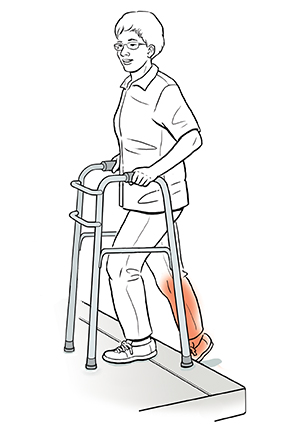
Stepping onto curbs
To step onto a curb with your walker:
-
Move your feet and the walker as close to the curb as possible.
-
Put your weight on both your legs. Then, lift the walker onto the sidewalk.
-
Step onto the sidewalk with the good foot first. Then, using the walker to support your weight, bring up the injured (weaker) foot.
Stepping off curbs
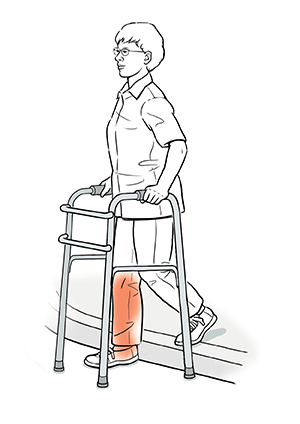
To step off a curb with your walker:
-
Move your feet and the walker as close to the edge of the curb as you safely can.
-
Lower the walker onto the street, keeping its back legs against the curb.
-
Using the walker to support your weight, lower your weaker foot first. Then step down with the other foot.
Follow-up care
Make a follow-up appointment as directed by your health care provider.
Online Medical Reviewer: Stacey Wojcik MBA BSN RN
Online Medical Reviewer: Thomas N Joseph MD
Online Medical Reviewer: Trina Bellendir PT
Date Last Reviewed: 10/01/2024
© 2000-2026 The StayWell Company, LLC. All rights reserved. This information is not intended as a substitute for professional medical care. Always follow your healthcare professional's instructions.


