Your pain is important. It can slow healing and keep you from being active. You may have acute or chronic pain. Both types of pain respond to treatment. Work with your health care professional. Together you can find relief.
Types of pain
Acute pain is caused by a health problem or injury. The pain usually goes away when its cause is treated. You may have pain:
-
From an illness or injury that needs emergency care.
-
After an operation, such as heart surgery.
-
During and after the birth of your baby.
Chronic pain lasts for longer than 3 months. It can be caused by a health problem or injury, such as arthritis or a shoulder strain. Chronic pain can also exist without a clear cause.
Your perception of pain
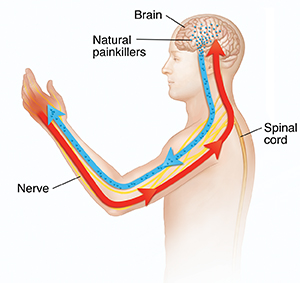
Pain is a complex phenomenon that involves many of the chemicals found naturally in the spinal cord and brain. All pain signals travel to the brain. The brain sends back signals to protect the body. The brain also makes its own painkillers (endorphins). These can help reduce the pain.
-
Pain starts in one or more parts of the body. In some cases, the site of the pain is far from its source.
-
Pain signals move through nerves and up the spinal cord.
-
The brain reads the signals as pain. Natural painkillers are released.
-
The feeling of pain can be reduced in this way.
Online Medical Reviewer: Jimmy Moe MD
Online Medical Reviewer: Kenny Turley PA-C
Online Medical Reviewer: Maryann Foley RN BSN
Date Last Reviewed: 04/01/2025
© 2000-2026 The StayWell Company, LLC. All rights reserved. This information is not intended as a substitute for professional medical care. Always follow your healthcare professional's instructions.


