Transcutaneous electrical nerve stimulation (TENS) is a therapy that uses mild electricity to treat pain. A TENS machine is a small gadget with wires. The wires attach to sticky electrode pads placed on your body. The machine then sends electricity to areas of your body through the pads.
How to say it
trans-kyoo-TAY-nee-uhs
Why TENS is done
TENS can help ease:
-
Nerve pain.
-
Pain after surgery.
-
Arthritis or other joint pain.
-
Other types of chronic body aches and pains.
TENS therapy is still being studied to understand how it works. It may interfere with pain signals moving along nerves on their way to the brain. Or it may activate chemicals in the body that can reduce pain. TENS pain relief is short-term. So the treatment can be done as often as needed.
How TENS is done
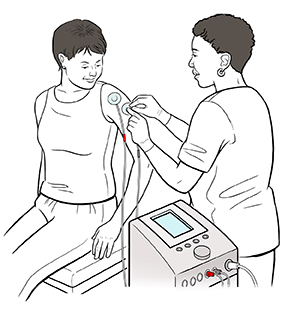
TENS therapy can be done in a medical office or at a physical therapy or chiropractic clinic. Or you may be shown how to do it at home. During treatment:
-
The areas where electrode pads will go will be cleaned. Your hair may be trimmed.
-
The health care provider puts electrode pads on or near the area of pain, or on other places on your body. Gel may be put on the pads first.
-
The provider attaches wires to the electrodes and to the TENS machine.
-
The machine sends electrical signals to the electrode pads. You may feel tingly or prickly in the area. Tell the provider if you feel burning instead.
The machine has controls for changing the signals from weak to strong as needed. The provider may try different levels to see which works best for you. If a stronger signal is used, your nearby muscles may twitch.
Your treatment may last from 30 to 60 minutes. After the treatment, the TENS machine is turned off. The electrodes will be removed. You may need the treatment 2 or 3 times a day.
Risks of TENS
Risks of TENS include:
-
Skin irritation at the electrode sites.
-
An allergic rash from electrodes, adhesive, or gel.
-
Electrical skin burns at the electrode sites.
-
Breakdown of a pacemaker or another implanted device.
TENS is not advised if:
-
You're pregnant or think you may be.
-
You have epilepsy or a history of abnormal heart rhythm.
-
You have a pacemaker or other metal implant in your body.
Author: Wheeler, Brooke
Online Medical Reviewer: Jimmy Moe MD
Online Medical Reviewer: Raymond Turley Jr PA-C
Online Medical Reviewer: Tara Novick
Date Last Reviewed: 04/01/2025
© 2000-2026 The StayWell Company, LLC. All rights reserved. This information is not intended as a substitute for professional medical care. Always follow your healthcare professional's instructions.


