Dismiss Modal

Definition

Common Spine and Disk Problems

Choose a preferred language

The most common serious back problems happen when disks tear, bulge, or burst open (rupture). In such cases, an injured disk can no longer cushion the vertebrae and absorb shock. As a result, the rest of your spine may also weaken. This can lead to pain, stiffness, and other symptoms.


Torn annulus

A sudden movement may cause a tiny tear in an annulus. Nearby ligaments may stretch.
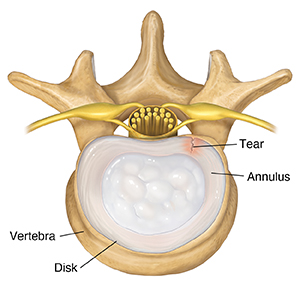
Top view of lumbar vertebra and disk showing tear in annulus.


Contained herniated disk

As a disk wears out, the nucleus may bulge into the annulus and press on nerves.
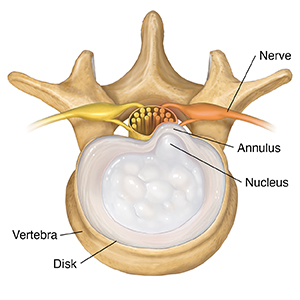
Top view of lumbar vertebra showing contained herniated disk.


Extruded herniated disk

When a disk ruptures, its nucleus can squeeze out and irritate a nerve.
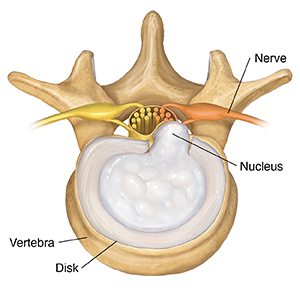
Top view of lumbar vertebra with extruded herniated disk.


Arthritis

As disks wear out over time, bone spurs form. These growths can irritate nerves and inflame facets.
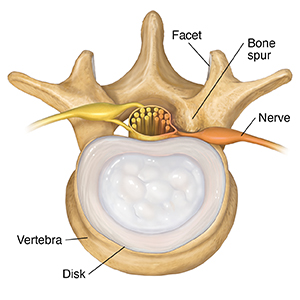
Top view of lumbar vertebra showing bone spurs.


Instability

As a disk stretches, the vertebrae slip back and forth. This can put pressure on the annulus.
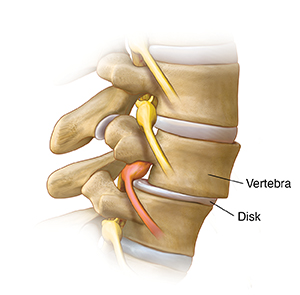
Side view of lumbar spine showing one vertebra slipping forward and pressing on nerve.


Spondylolisthesis

With this condition, one vertebra has moved forward or backward, in relation to the one above or below it. This causes a crack (stress fracture) in the areas that link the vertebrae together. This may put pressure on the annulus, stretch the disk, and irritate nerves.
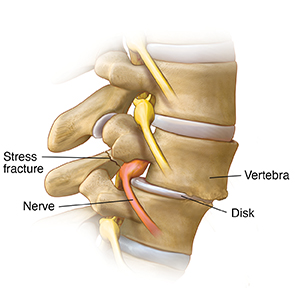
Side view of lumbar spine showing spondylolisthesis and stress fracture.

© 2000-2026 The StayWell Company, LLC. All rights reserved. This information is not intended as a substitute for professional medical care. Always follow your healthcare professional's instructions.



Make an Appointment

Make an Appointment

Find a Doctor

Find a Doctor

Find a Location

Find a Location

Related Services

Stroke & Neuroscience Center

Related Articles
Read article
Brain Health
Migraines and Cluster Headaches

With a migraine, you may have nausea and vomiting and be sensitive to light and sound. You may also have warning signs, such as flashing lights or loss of vision, before the pain starts. Cluster headaches recur in groups for days, weeks, or months.

Read article
Brain Health
What Is Traumatic Brain Injury (TBI)?

A traumatic brain injury (TBI) is a sudden jolt to your head that changes the way your brain works. Learn more about the types of TBI, the symptoms, and what you can do to help with your recovery.

Read article
Brain Health
Anatomy of the Brain

Learn about the brain, its parts, each part's functions, and how the brain is protected.

Read article
Brain Health
The difference between delirium and dementia

Dementia and delirium are both health conditions that change a person's ability to think clearly and care for themselves. They do share some similar symptoms. But they have different causes, treatment, and outcomes.
