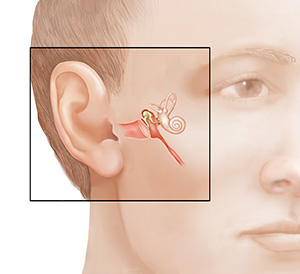
The ear is a complex and delicate organ. It collects sound waves so you can hear the world around you. The ear also has a second function—it helps you keep your balance.
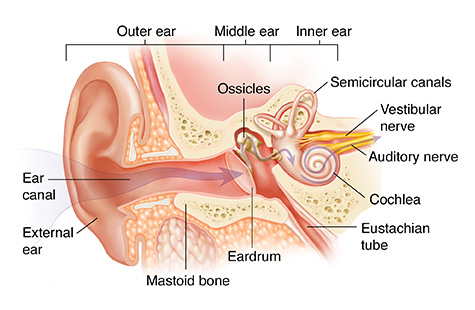
Your ear can be divided into 3 main parts. These are the outer ear, the middle ear, and the inner ear. The outer ear and middle ear help collect and amplify sound. The inner ear converts sound waves to messages that are sent to the brain. The inner ear also senses the movement and position of your head and body. It helps you maintain your balance and see clearly, even when you change positions.
Here's how the different parts of your ear work together to help you hear and stay balanced:
-
Mastoid bone. This surrounds the middle ear.
-
External ear. This collects sound waves.
-
Ear canal. This carries those sound waves to the eardrum.
-
Eardrum. This vibrates from the sound waves, setting the middle ear bones in motion.
-
Middle ear bones (ossicles). These vibrate, sending the sound waves to the inner ear. When the ear is healthy, air pressure stays balanced in the middle ear.
-
Eustachian tube. This helps control air pressure in the middle ear.
-
Semicircular canals. These help maintain balance.
-
Vestibular nerve. This carries balance signals to the brain.
-
Cochlea. This picks up the sound waves and makes nerve signals.
-
Auditory nerve. This carries the sound signals to the brain.
Online Medical Reviewer: Ashutosh Kacker MD
Online Medical Reviewer: Rita Sather RN
Online Medical Reviewer: Tara Novick BSN MSN
Date Last Reviewed: 08/01/2023
© 2000-2026 The StayWell Company, LLC. All rights reserved. This information is not intended as a substitute for professional medical care. Always follow your healthcare professional's instructions.


