Why does your nose look the way it does? And what goes on inside a nose to let a person breathe easily? Learning the anatomy of the nose can help you better understand the answers to these questions.
The outside view
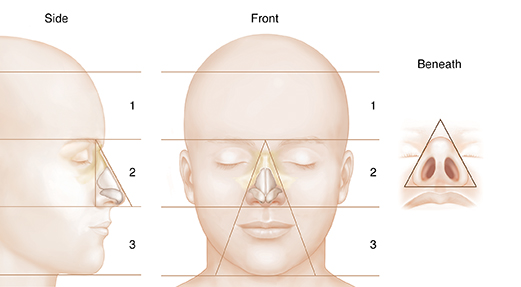
One way to tell if a nose fits well with a face (aesthetics) is to divide the face into 3 equal parts (thirds). The nose should fit in the middle third. Then, thinking of the nose as a triangle can help you see the best size and shape for the nose.
-
From the front. Imagine a triangle starting at the top of your nose and extending to the outer corners of your mouth. Does your nose fit inside that triangle? The nose itself should also be shaped like a triangle. It should balance with the length and width of your face.
-
From the side. Imagine a triangle with 1 side going along the bridge of the nose and another going out from the base of the nose. Does your nose fit within this triangle? The tilt of the tip should also balance with the forehead and chin.
-
From beneath. The nostrils and tip of the nose should also form a triangle.
Online Medical Reviewer: Ashutosh Kacker MD
Online Medical Reviewer: Rita Sather RN
Online Medical Reviewer: Tara Novick BSN MSN
Date Last Reviewed: 04/01/2024
© 2000-2026 The StayWell Company, LLC. All rights reserved. This information is not intended as a substitute for professional medical care. Always follow your healthcare professional's instructions.


