Taking your pulse is a way to measure your heart rate. When you take your pulse, you are feeling the force of blood as it’s pumped from your heart into your body. You may be asked to take your pulse regularly. Or you may just need to take it when you exercise or when you feel something is wrong.
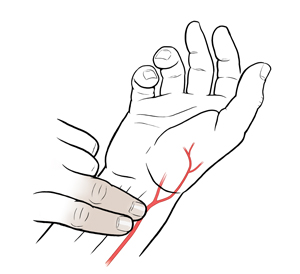
Step 1. Find your pulse
-
With your first 2 fingers, press lightly on the inside of your wrist, just below the base of the thumb. You should not be pressing on a bone. Don't use your thumb.
-
The beats you feel are your pulse. If you can’t find your pulse, try moving your fingers slightly to a new spot.
Step 2. Take your pulse
-
Count the beats you feel in your wrist as you watch the second hand on a clock. You may be told to count the beats for 30 seconds, then multiply that number by 2. Or you may be told to count for a full minute. Both methods should give you about the same result.
-
The number you get is your pulse measurement. It's measured in beats per minute (bpm). A normal pulse when you are at rest is between 60 and 100 beats per minute. The beats should be regular (evenly spaced). If the beats are not regularly spaced, let your health care provider know.
Step 3. Write down the results
-
Write down your pulse each time you take it. You may be asked to bring your results with you each time you visit your provider.
Online Medical Reviewer: Ronald Karlin MD
Online Medical Reviewer: Stacey Wojcik MBA BSN RN
Online Medical Reviewer: Steven Kang MD
Date Last Reviewed: 02/01/2025
© 2000-2026 The StayWell Company, LLC. All rights reserved. This information is not intended as a substitute for professional medical care. Always follow your healthcare professional's instructions.


