Treatment

Fetal Positions: Special Care During Childbirth

Choose a preferred language

A baby (the fetus) often moves down between the pelvic bones (descend) before birth. If this is your first pregnancy, this may happen 2 to 4 weeks before labor. With repeat pregnancies, the baby may not “drop” until labor begins. The baby usually moves down headfirst. If your baby is not in a safe position for birth, or if there is a problem with the placenta, you may need special care. A cesarean section delivery may be needed.
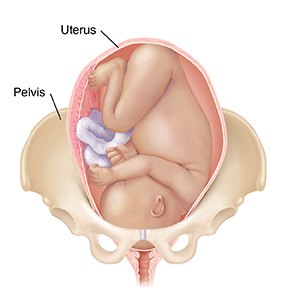
Front view of full-term fetus in uterus between pelvic bones with head down.


Conditions that require special care

Cephalopelvic disproportion (CPD). Baby’s head or body is too big for the pelvis.
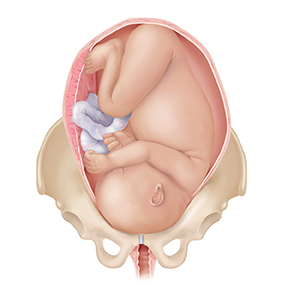
Front view of full-term fetus in uterus between pelvic bones, with head down. Head and body are too large for birth canal.

Breech position. Baby is positioned with feet or buttocks first.
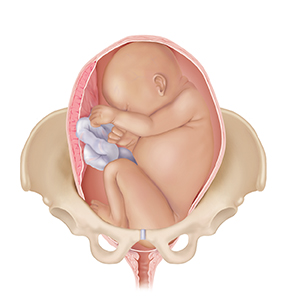
Front view of full-term fetus in uterus between pelvic bones with head up, showing breech position.

Transverse position. Baby lies horizontally across the pelvis.
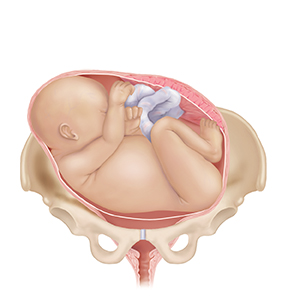
Front view of full-term fetus in uterus between pelvic bones with fetus' body lying sideways over birth canal, showing transverse position.

Placental abruption. Placenta separates from the uterus.
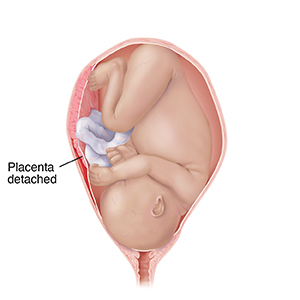
Front view of full-term fetus in uterus in pelvic bones with head down. Placenta is detached from wall of uterus showing placental abruption.

Placenta previa. Placenta blocks the cervix.
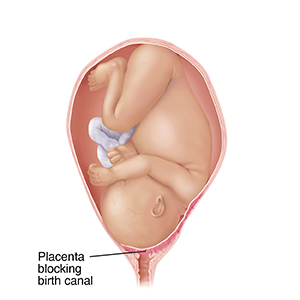
Front view of full-term fetus in uterus between pelvic bones with head down. Placenta is blocking birth canal, showing placental previa.

© 2000-2026 The StayWell Company, LLC. All rights reserved. This information is not intended as a substitute for professional medical care. Always follow your healthcare professional's instructions.


Make an Appointment

Make an Appointment

Find a Doctor

Find a Doctor

Find a Location

Find a Location
Related Articles
Read article
OB/GYN
Anesthesia Options for Labor

Anesthetics may numb only 1 region of your body, or they may let you sleep during surgery. These medicines are given by trained specialists. Whenever possible, regional anesthesia is used so you can be awake during your baby's birth.

Read article
OB/GYN
Pregnancy and Childbirth: Abdominal Cerclage

A cerclage is a procedure to close the cervix during pregnancy. It is done to help prevent miscarriage or premature birth. Here is what you need to know about the procedure.

Read article
OB/GYN
Methotrexate for Ectopic Pregnancy

An ectopic pregnancy means that the fetus is growing outside the uterus, usually in the fallopian tube. The fetus can't survive there, and the pregnancy can't be saved. Treatment with methotrexate is an alternative to surgery. Read on to learn more.

Read article
OB/GYN
Reasons for a Cesarean Section Birth

In most cases, a cesarean section birth is not expected. It may be needed because of concerns about the baby, the mother, or the baby's passage through the birth canal.

