Introduction
Here are some examples of exercises for you to try. The exercises may be suggested for a condition or for
rehabilitation. Start each exercise slowly. Ease off the exercises if you start to have pain.
You will be told when to start these exercises and which ones will work best for you.
How to do the exercises
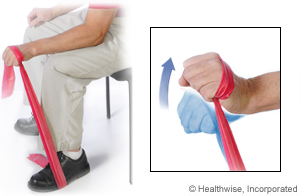
Resisted wrist extension
-
Sit leaning forward with your legs slightly spread. Then place your forearm on your thigh with your
affected hand and wrist in front of your knee. -
Grasp one end of an exercise band with your palm down. Step on the other end.
-
Slowly bend your wrist upward for a count of 2. Then lower your wrist slowly to a count of 5.
-
Repeat 8 to 12 times.
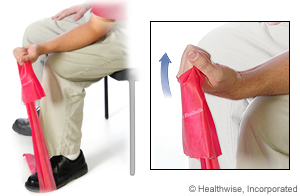
Resisted wrist flexion
-
Sit leaning forward with your legs slightly spread. Then place your forearm on your thigh with your
affected hand and wrist in front of your knee. -
Grasp one end of an exercise band with your palm up. Step on the other end.
-
Slowly bend your wrist upward for a count of 2. Then lower your wrist slowly to a count of 5.
-
Repeat 8 to 12 times.
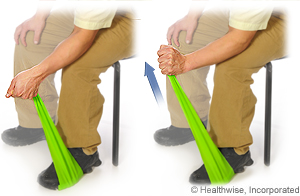
Resisted radial deviation
-
Sit leaning forward with your legs slightly spread. Then place your forearm on your thigh with your
affected hand and wrist in front of your knee. -
Grasp one end of an exercise band with your hand facing toward your other thigh. Step on the other end.
-
Slowly bend your wrist upward for a count of 2. Then lower your wrist slowly to a count of 5.
-
Repeat 8 to 12 times.
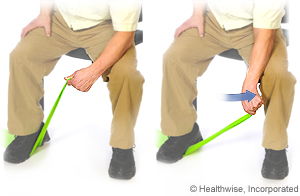
Resisted ulnar deviation
-
Sit leaning forward with your legs slightly spread. Then place your forearm on your thigh with your
affected hand and wrist by the inside of your knee. -
Grasp one end of an exercise band with your palm down. Step on the other end with the foot opposite the
hand holding the band. -
Slowly bend your wrist outward and toward your knee for a count of 2. Then slowly move your wrist back
to the starting position to a count of 5. -
Repeat 8 to 12 times.
Resisted forearm pronation

-
Sit leaning forward with your legs slightly spread. Then place your forearm on your thigh with your
affected hand and wrist in front of your knee. -
Grasp one end of an exercise band with your palm up. Step on the other end.
-
Keeping your wrist straight, roll your palm inward toward your thigh for a count of 2. Then slowly move
your wrist back to the starting position to a count of 5. -
Repeat 8 to 12 times.
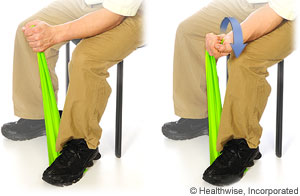
Resisted supination
-
Sit leaning forward with your legs slightly spread. Then place your forearm on your thigh with your
affected hand and wrist in front of your knee. -
Grasp one end of an exercise band with your palm down. Step on the other end.
-
Keeping your wrist straight, roll your palm outward and away from your thigh for a count of 2. Then
slowly move your wrist back to the starting position to a count of 5. -
Repeat 8 to 12 times.
Follow-up care is a key part of your treatment and safety. Be sure to make and go to all
appointments, and call your doctor if you are having problems. It's also a good idea to know your test results
and keep a list of the medicines you take.
Current as of: July 17, 2023
Content Version: 14.0
Care instructions adapted under license by your
healthcare professional. If you have questions about a medical condition or this instruction, always ask
your healthcare professional. Healthwise, Incorporated disclaims any warranty or liability for your use of
this information.



